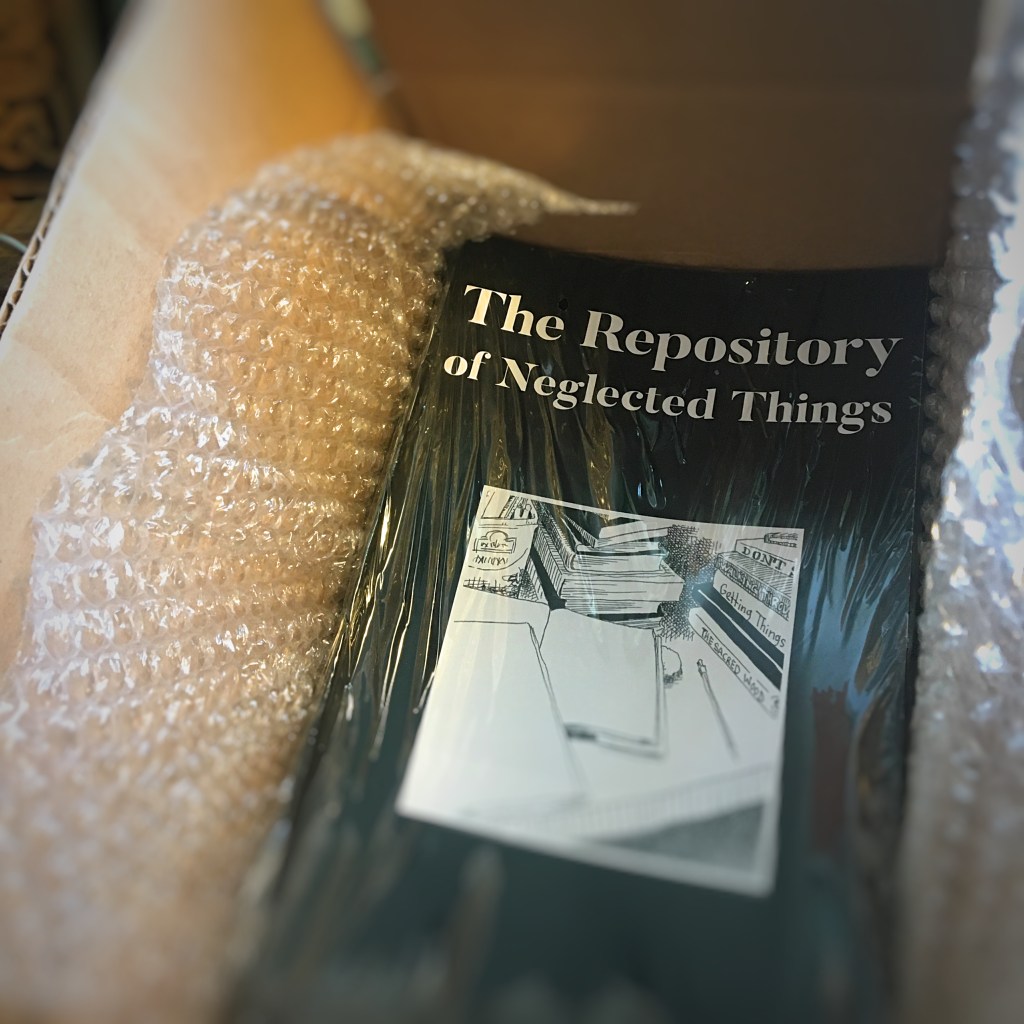
The Repository of Neglected Things, published

Why was The Repository of Neglected Things written, illustrated and published?

The idea of this published project began grudgingly.

First, some background. Old sketchbooks, from decades ago, resurfaced when I cleaned the garage a year or so ago. 

“What am I going to do with these?” I asked my wife. 

“Save them,” she answered. 

The cleaning plan was to throw away or sell garage items. Throwing away these large sketchbooks was not an option. And neither was selling them. The black cloth cover hardback sketchbooks varied in sizes. Most of them were nine inches wide by 12 inches high with 96 to 110 pages. Some were smaller. The smallest was four inches wide by six inches high. The largest was 11 inches wide by 14 inches high. 

A navy blue cloth cover hardback sketchbook made its way from the garage to my desk. It measured six inches wide by nine inches high. The little blue book was half full of sketches. Or half empty. As many as 40 blank pages. My wife encouraged me to fill the blue cloth sketchbook with drawings. My children asked me to make more drawings. One of the children requested I storyboard a comic book. Or picture book. Reluctant, I began a few pencil drawings. My wife bought me some brush markers. I added more sketches. Once the blue sketchbook was filled with drawings, I reviewed it. Should I return it to the garage with the other black sketchbooks?

Summer faded to Autumn. A plan formed around the recently filled blue sketchbook. A mission to show my children that they can write and illustrate their own stories, their own books. The goal. Showcase their work in a print publication. A comic book. With creativity and energy they pulled their stories together. They learned about the process of creating a story, illustrating, organizing pages and layout, and basic pre-press tasks. The stories from the children featured one about cats baking muffins and another of a mouse warrior. My contribution to the anthology was selected drawings from the blue sketchbook. The art inside spanned twenty years. A single narrative titled “The Little Blue Sketchbook” tied the drawings together.

Finally, the publication The Repository of Neglected Things arrived. The children celebrated by flipping through the pages. They paused to examine their contributions. They read selections to each other. And then collected copies to send to friends and family. One child asked, “So, when do we publish the next edition?”

Putting the finishing touches on a new book design

Constellarium_Cover_Final
Since the publisher posted the following on Facebook last night, I guess it is alright to unveil a new book I designed:

Jordan Rice’s debut poetry collection, CONSTELLARIUM, a finalist for the 2015 Orison Poetry Prize, is now available for pre-order at a discounted price! Order now and be among the first to receive the book when it’s released in April.

“Constellarium is a bold announcement of a new poetic voice to be reckoned with. These poems make us stare down shame and celebrate transition, celebrate the body inside. Jordan Rice does not flinch from what society would have us try to look away from, instead she carefully constructs a book in which we are forced to reckon, layer by layer, with her being. Let us be thankful that such a voice exists, that it is brilliant and shattering, and here to take us all on her journey.” –Fatimah Asghar

The process of cover design is exciting. Especially when the title of the project is constellarium.

There are so many stories behind the cover design that would be fun to share. Like, for example, how the kidlingers enjoyed the image of cetus — how cetus does not look like any image of a whale they have ever seen in a picture book. And how the eldest kidlinger is writing a report about rhinos.

And how a species of rhino has been reported extinct. And we wonder if these old drawings are accurate. And that maybe the cetus represented in the book cover art is correct. But maybe that species of ceti (is that the correct nominative plural of cetus, Latin students?) is now extinct.

Maybe these behind-the-scenes stories are more interesting to me than you.

See if you can find cetus in the cover art by pre-ordering Jordan Rice’s Constellarium!

The “elevated” platform of self-publishing

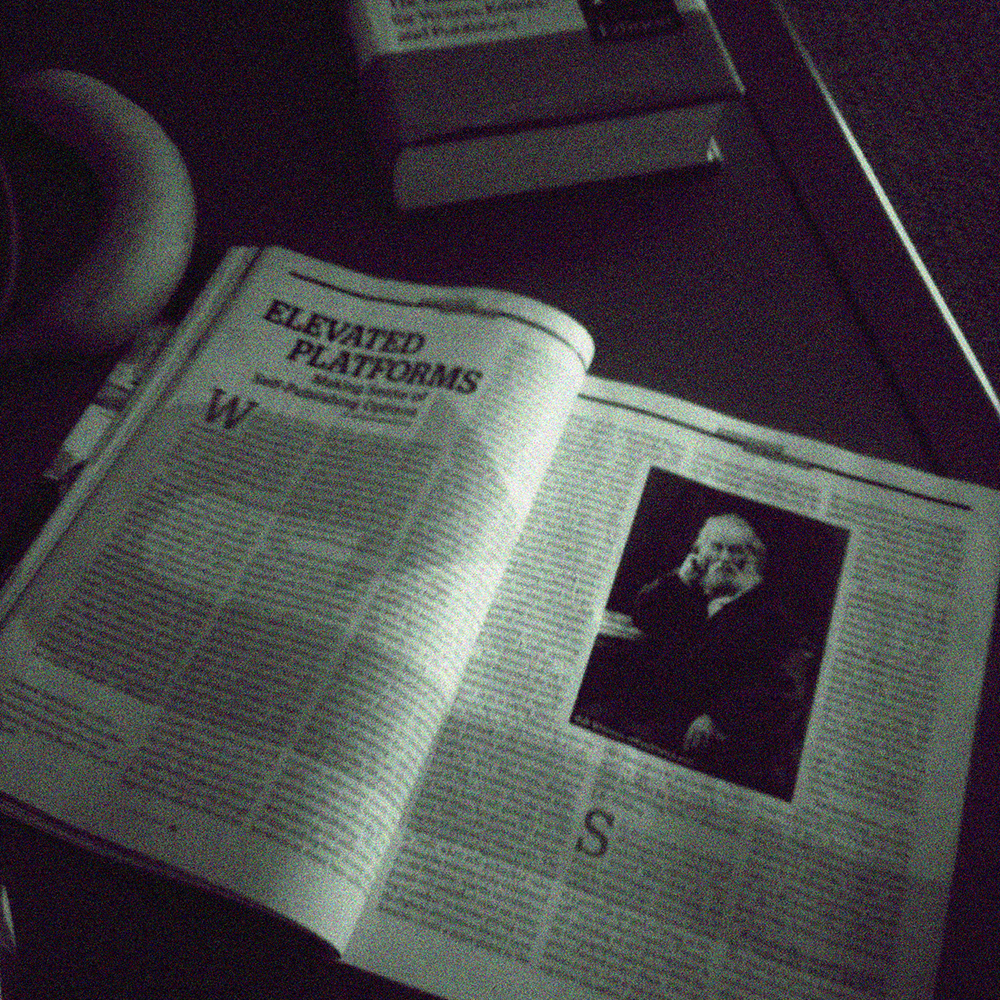
Poets and Writers - Self Publishing

For the last few years, Poets & Writers highlights the independent publishing scene in America. This year is no different.

Recently arrived in the post is the November/December issue of Poets & Writers. In the past, it has been my practice to read each issue from cover to cover. However, (and in light of my post last week that elicited much conversation: Are trade publishers gatekeepers?[1]), I abandoned protocol and started on the self-publishing special section.

As I am still reading and processing the articles in this issue, one item caught my attention that I would like to share. Reportedly, more than 391,000 books were self-published in 2012.[2] That is a large number of self-published books. To be honest, I may have read only a handful of self-published works that year. An article in Poets & Writers offer some perspective on the matter. I would like to learn your response to the following:

A highly regarded agent recently remarked that the odds are stacked heavily against self-published authors—that only three or four titles really “make a splash” each year.[3]

NOTES:
[1] Closing out the blog post, I asked: “What are your thought about publishers as gatekeepers?” One commented suggested that publishers “think that they are [gatekeepers], but they’re not. They are commercial retailers…. They buy what sells. The quality only needs to be high enough not to send readers screaming.” Someone else commented that “I depend on publishers to be gatekeepers. While I know that they publish a lot of crap and don’t publish a lot of great stuff… I still believe that the ratio of things I’d enjoy reading to things I wouldn’t is higher among traditionally published books than among self-published ones. I’m sure I miss some really great reads this way, but I just don’t feel I have time to wade through the slush pile myself.”
[2] Jason Boog, Galleycat, “Bowker Counted 391,000+ Self-Published Books Last Year,” October 9, 2013, accessed October 23, 2013, http://www.mediabistro.com/galleycat/bowker-counted-391000-self-published-books-in-2012_b78844
[3] Kevin Larimer, Poets & Writers, “Self-publishing Perspectives,” November/December 2013

Are trade publishers gatekeepers?

First quarter books

In a book cover designer LinkedIn group, the question came up, Do you think publishers are “gatekeepers?”[1] (For reference, please read this blog post provided by Dave Bricker.[2])

Too often I read self-publishers complain how the Big Six dominate retail/distribution options. Or trade publishers denigrate self-publishers as buffoons. In Dave Bricker’s blog post, he  offers that it is not an “us versus them” scenario. It is a competitive marketplace. Both publishing options are viable. Additionally, both options are equally challenging.

One contributor offered that publishers are like brands. While another contributor reminded the group that publishing is a business.

The article sparked additional thoughts in a different, yet related, line of thinking. First, if trade publishers are brands, should they publish inferior quality literature simply because it’s good business? Next, if publishers do pursue that path, what does that say of their brand?

Dave responded to my questions in this manner:

We indie publishers enjoy the luxury of indulging in a bit of artistic snobbery, but we don’t have conglomerates to support and we’re rarely presented with the opportunity to grow rich by “selling out.”

Ultimately, I suppose we’re all trying to make money and offer the highest quality books we can. One could make a compelling argument that a single “less than excellent” blockbuster could finance a whole lot of artistic expression. It’s a bit like wildlife advocates supporting zoos. A little captivity is acceptable if it supports a certain amount of conservation in the wild.

I love that line: “It’s a bit like wildlife advocates supporting zoos.”

What are your thought about publishers as gatekeepers?

NOTES:
[1] Dave Bricker, LinkedIn group, book cover designer, “Gatekeepers and Self-Publishing,” December, 2012 accessed October 13, 2013 Gatekeepers and Self-Publishing
[2] Dave Bricker, TheWorldsGreatestBook.com, “Gatekeepers and Self-Publishing,” November 25, 2012 accessed October 13, 2013 Gatekeepers and Self-Publishing

Keep calm and write something

Back in January I submitted more than 50 poems to various publishers. So, how many poems have been accepted? or rejected? More on that later….

[read more]

UPDATE: This blog post is available as part of an audio podcast.

Listen here:

Or listen on:
PodOmatic: coffeehousejunkie.podomatic.com
SoundCloud: soundcloud.com/coffeehousejunkie

E-book: How long does it take to write a haiku?: and other stories

Purchase the e-book Kindle Edition for $0.99!

What do you think about when you see a stack of books? In this short collection of stories you will also learn what a creative director thinks of when he sees a stack of books. Who is the audience for your poems? Is possible to write in your sleep, or not?

Do children’s books sell as e-books?

DoKidsEbooksSell_zhivago_lomo
Photo courtesy of @mxmulder

Let’s face it, e-books are no longer a novelty. With the Kindle, Kobo, Nook and other e-reader devices, the transition to a digital reading experience is no longer a discussion. They are here to stay. But is the e-book market just for adults? How well do children’s books sell on this new platform?

Last year, I worked on a half dozen or so children’s books. Not books I’ve written, mind you, but I did design covers, inside layout and typesetting. All of the titles are available on various e-reader devices. Each book features fully illustrated pages (the industry trade refers to them as picture books) and they print at various formats. The most common — and standard to the trade — is a 32-page, 8.5″x11″, colored ends hardcover book.

This is where the question gets interesting: Do children’s books sell as e-books? According to one report,

“children’s and young adult digital book revenues exploded nearly 300 percent…”[1]

Those sales numbers are quite convincing. Authors request e-books of their picture books in addition to their traditionally printed picture books. At least, the authors I work with are convinced by the published industry sales reports. Best I can tell is that young adult books perform much better than picture books even though children’s and young adult books are lumped together in a single category.

My experience is that the iPad provides the best possible interface as an e-reader with brighter colors and fluid user experience. The more popular e-readers (i.e. Kindle and Nook) seem clumsy by comparison leading some to believe that the e-reader device is a transitional technology that is soon to be replaced by the tablet.[2] Both Kindle and Nook scale down a large format picture book to the default viewing area specific to the individual device. Though the iPad has the better picture book experience, I’ve noticed that children are more interested in apps than e-books.

So, what is an author of children’s picture books to do? Here are some things to keep in mind as a children’s book author:

  • A picture book that is interactive (using apps to feature audio, video, etc.) sells better than a static digital e-book.
  • Young adult fiction titles sell better as an e-book than picture books.
  • Publishers typically provide both print and digital products, and it is wise to have the book in as many formats as financially viable.
  • Scholastic published a report on the reading habits of children stating that: “Eighty percent of kids who read ebooks still read books for fun primarily in print.”[3]
  • The same report shares that: “Fifty-eight percent of kids… want to read books printed on paper even though there are ebooks available”[4]

The tactile interaction with a physical book is an important part of the reading experience for children. In her book The Writing Life, Annie Dillard writes,

“The written word is weak. Many people prefer life to it.”

As e-books gain market share, the written word — whether print or digital — will always compete with life. Readers still seek to retreat into books that don’t offer the distraction of emails, hyperlinks, social media updates, Youtube videos and the like. It’s a choice the reader and the author must make.

NOTES: What prompted this post is a discussion posted on the LinkedIn group Ebooks, Ebook Readers, Digital Books and Digital Content… The specific discussion thread is here http://www.linkedin.com/groups/Do-childrens-books-sell-as-1515307.S.212309551
[1] Jason Boog, “Children’s & Young Adult eBooks Saw Nearly 300% Growth,” Galleycat, September 7, 2012 accessed February 19, 2013 http://www.mediabistro.com/galleycat/category/sales-stats
[2] Dan Eldridge, “The Disappearing Market Share of the E-Reader: Is it now a transitioning technology?,” Teleread.com, November 1, 2012 accessed February 19, 2013 http://www.teleread.com/e-ink/the-disappearing-market-share-of-the-e-reader-is-it-now-a-transitioning-technology/
[3] Kids & Family Reading Report, Scholastic, accessed February 19, 2013 http://mediaroom.scholastic.com/kfrr
[4] Kids & Family Reading Report, Scholastic, accessed February 19, 2013 http://mediaroom.scholastic.com/kfrr

Rarely do I reblog someone’s blog post, but this is extremely useful for authors and graphic designers who are working on a children’s book.

Tara Lazar's avatarWriting for Kids (While Raising Them)

Editorial Anonymous provided a great explanation of basic picture book construction a few months ago.

At that time, I skimmed the info. Today, I’m studying it.

Why? An editor asked me to make page breaks on my current manuscript. And know what? I had more page breaks than a 32-page picture book would allow! Whoops. I knew that my manuscript had to fall within the 500- to 800-word length, but I had neglected to pay attention to logical page breaks.

The editor said, “Page turns can make or break a book, and it can be helpful to an editor to see how you envision the text.”

In a 32-page picture book, you don’t actually have 32 pages for your story. You only have 24 pages since 8 are used for the book ends, copyright and title. And 24 pages translates to 12 spreads (an illustration that spans the two opened pages…

View original post 410 more words

Anatomy of a children’s book

Updated - Anatomy of a Children's Book
Updated – Anatomy of a Children’s Book

UPDATE: A new image of the anatomy of a children’s book replaced the smartphone photo.

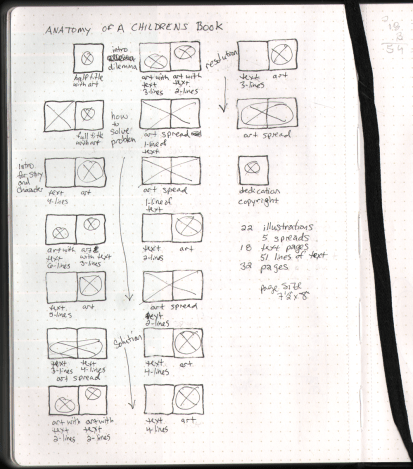
This crude sketch was quite popular at a recent meet-up of illustrators and comic book artists. Basically, the topic of children’s books came up and I got the impression that the idea of creating a children’s book was intimidating to artists. As well it should be. But it is not a path of labyrinthian impossibility. The big question is how to do it.

So, to encourage these artists, I showed them this dissection of a children’s book: 22 illustrations (five spreads), 18 pages of text (51 lines to be specific) an 32 pages (including title pages, front matter and back matter), intro story and character on page four, intro dilemma on page 14, how to solve problem (pages 15 to 23), problem solved on page 24 and resolution on page 28. It didn’t take long before a several artists were asking to take a photo of this anatomy of a children’s book with their smart phones.

Like all recipes, what you do with the ingredients (i.e. text, words and pages) is up to the artist and writer. And, like any good disclaimer, results do very.

How to capturing abstract ideas in a book cover design

How do you capture an abstract thought for a book cover design? That’s the question one person left in the comments section to Judging a book by its cover.

That is a challenge. A lot of abstract ideas — like love, grief, joy, freedom, etc. — have emotional and psychological weight. Photography is an easy tool to use in conveying physical responses to abstract thoughts. Photos illustrating love or grief become cliché. For example: how many books can you find at a local book seller on the topic of grief of a loved one that includes sun bursting through voluminous clouds? There are reasons for a majority of the bereavement books have similar titles — primarily marketing. Readers looking for books on how to cope with grief in a book store find themselves staring at a shelves of cloud cover books. So how does a graphic designer create a cover that competes with all the cloud-covered-grief-books?

Here are two other tools to consider: color and shape.

Color

Color psychology informs me what colors might work best to address a book on the topic of grief, freedom or spirituality. The challenge arises frequently — due to an enormous amount of books published every year — that most books on the topic of grief utilize the same color scheme or photographs of a path leading through a forest with a bright patch of light at the end or the ever-present sun breaking through the clouds. So I turn to color psychology as a tool to design a book cover dealing with the abstract concepts of grief, joy, love, etc. There has been a lot of research in this field to learn from. For example, blue (depending on the shade or tint) offers a feeling of peace, tranquility, confident, and as reliable as the sky and ocean. But blue can also be cold and corporate (again, depending on the shade or tint). Interestingly, brown can express reliable and authenticity.

Shapes

Recently, I’ve turned to the psychology of shapes and patterns as a way to define abstract ideas like endurance, peace or joy. According to research, there are three main categories of shapes: geometric, organic and abstract. Other distinctions remind me of primary school including: circles, squares, triangles, spirals, and more. Also, the orientation of the shape is essential — horizontal and vertical. Squares and rectangles are common but express peace, stability, conformity or other abstract concepts. For example, a horizontal rectangle expresses confidence in much the same manner as the color blue. Whereas a spiral shape my best represent grief as it expresses the idea of death, life and transformation.

As I share the psychology of color and shape with authors with whom I am designing their book covers, they often need to be educated on the visual vocabulary of these ideas. Most of the authors understand the premise of how color, shapes and patterns express the content of their book. Additionally, most of the authors prefer a photographic cover design. This is a bit off in my mind, because what is a photograph but a composition of colors and shapes? Is there a lack of visual literacy in our culture? Or is the graphic design community a cloistered cult of artists that do not share secrets with the outside world?

As I design book covers, these are the tools I fall back on consistently: color and shapes.

Three ways self-published authors fail

“Only idiots and the self-deluded think that being able to self-publish qualifies them to write,” concludes one person commenting on Two reasons why not to self-publish your book. It’s true. Not every self-published author writes well. For that matter, not every best-selling author writes well. I do agree in part with that comment–the logical part, not the jaded part. Like I said before, I am an advocate of self-publishing, but my views are changing.

Regarding self-publishing, I wrote a multi-part series titled The Economics of Writing. The basic premise of the series is this question: Why should a poet/writer spend his/her money on literary contests when they might self-publish his/her own work? You can read the whole series by following the links. What prompted the series was:

  1. I’ve been in publishing for a while and know how much it costs to produce and distribute print products and
  2. I read a story about a writer that spent more than $14,000 in a seven-year period on contest entry/reading fees, related postage, sample journals, literary memberships and writing conferences/workshops and won a $500 cash prize during that period.

I’ll avoid the analysis of literary contests [read about them in the second part of the series], and move to notable poets and writers who have self-published their work: Margaret Atwood, T.S. Eliot, Robert Service, Nikki Giovanni and Viggo Mortensen [read more details in the third part of the series].

When you consider the amount of time and energy–not to mention money–it takes to publish a book, self-publishing is an option to consider if you don’t want to wait for a publishing house to release your product. A poet and/or writer may spend years working with an agent to secure a book deal with a traditional publishing house. Whereas, self-publishing a book can make its way to the market in a matter of days or weeks.

Most self-published authors fail with their book releases in the following three areas:

  1. Cover design. And in general, book design. Just because you cleverly wrote your major literary work in MS Word does not mean you can print it in MS Word. Let a professional graphic designer package your literary endeavor. Further, just because you have Adobe products loaded on your fancy schmancy MAC machine, doesn’t qualify you as a designer either. Book design is not the same as designing a web site (that you really borrowed from WordPress or some other blog platform and told your client you designed their web site *sigh*). A book cover is the movie poster for the book. It must invite, entice, and coax readers to pull the book from the retail shelf (or etail shelf), read the back blurbs and first chapter, and ultimately buy the book.
  2. Editing. First draft, best draft is not the best practice in selling books. Having your ever-loving mother to review your manuscript is not that same as getting your manuscript edited. Even a good writing group is not enough–but it is a very good start. Hire a good editor to work on your literary masterpiece. A good editor will make a huge difference in the final product. So much of self-published books are deficient in quality work. There are gruesome typos, grammatical crime scenes, and abominable stylistic failures. A good editor is like a good film producer–a poet/writer may have the vision, but the editor knows best how to articulate it to readers. A good editor is one of your best friends. The last thing you want to do is release a book product that you immediately have to print a second revised edition because you used “their” instead of “there.”
  3. Production efficiency and quality. The financial bar has been lowered in matters of producing a book. Print-on-demand options are more affordable now than ever before. But more affordable doesn’t always equate to quality book product. A lot of do-it-yourselfers enjoy the look of the Etsy-ish, handcrafted book products that clutters the indie poetry and zine scene. And that’s fine. Those products are souvenir. People who purchase those items understand that they are a souvenir, book art object. But that option is more expensive than one might suspect. Consider a book’s cover price of $12 per copy for a 64-page literary chapbook. Most traditional publishers have a production markup of no less that 12 times. If, for example, the cover price is $12, than the book’s production cost–printing cost, cover art, book design, etc.–on a 1000 copies print run is $1 per copy. Most self-publishers don’t consider this fact and usually spend $6 per copy on a print run at Kinkos for a run of 100 copies. At that rate, it’s a hobby not a business.

I’ve been on both sides of the argument. I’ve self-published books that failed and succeeded. I launched two book imprints within a media organization that sold over 30,000 books in a couple of years. And here’s where I’m changing my position on self-publishing versus traditional publishing: idealism versus reality. Poet and blogger extraordinaire, Ron Silliman, offers these thoughts on idealism versus reality when he suggests that it would be ideal:

…if all bookstores carried every book of poetry that is in print… and if all poets had equal access to book publication.… But until then, it’s the real world I’m going to engage with…

So, where does that leave authors who don’t have a literary agent and don’t want to wait years and years to get their work published? Co-publishing. There are several reputable publishing houses that offer co-publishing services. A poet/writer still pays for the production of the book product, but the publishing house offers editors, publishers with decades of experience, a professional art department, a public relation staff, a warehouse facility, events coordination, distribution and other services. Consider the question that sparked the multi-part series I wrote. As a writer, would you rather spend seven years and $14,000 trying to win a literary contest and/or land a book deal? Or spend $14,000 and seven years selling your book, earning new readers and working on your upcoming books?
Two reasons why not to self-publish your book

Confession: I am an advocate of self-publishing. I have been for years. But my views are changing on the matter due to the glut of poorly written self-published books being released each year.  Serendipitously, I found this article in the London Evening Standard that offers two reasons why not to self-publish: 1) publishers and 2) editors.

Authors need publishers more than ever when there are so many voices out there competing for our attention. As Horowitz rightly says, the main raison d’être of a publisher is to provide the author with a skilful editor who can turn a sow’s ear into a silk purse.

Editors are the midwives of great literature. T S Eliot’s The Wasteland wouldn’t have been the masterpiece it is if it hadn’t been edited by Ezra Pound and his wife, Vivien.

The death of publishing is greatly exaggerated. We will still need publishers as long as we read books, just as we still need critics to review those books. It is part of the great filtering process of literature and culture. (link: Self-publishing makes us think we can write)

Any questions?

Judging a book by its cover

For me, every book cover I design begins with pencil sketches that eventually lead to ink drawings. Actually, I suppose it begins prior to that. The author receives a pre-publication questionnaire from me prior to the design process. The questionnaire asks the author what is his/her elevator pitch, what are the pillars of the book (i.e. what are three main concepts/ideas in the book?), and what is the book’s key audience? There are more questions that help me prepare for the design process, but reading through that document helps me form an idea of who the author is, what the book is about and how best to represent the book’s content with an attractive cover.

Then I receive the manuscript a few weeks later and begin reading the author’s work. This helps try to envision in my mind an iconic poster image. For me, a book cover is the equivalence of a film poster. At this stage, I produce some concept drawings (like the one’s pictured) and research color schemes and subject themes that I plan to use in the cover design. After a couple rounds of emails with the author, I proceed to the full-color design phase.

The full-color design is often photographic, as in the case of this sample, but can also feature illustrated work or typographic designs. An illustrated cover is sent to a freelance artist who spends a week or so producing the cover art. The final cover design pulls together all the elements (art, photo, type and copy) to present a cover that, in theory, sells a 1000 to 3000 copies on face value. I know what you’re thinking, but books really are judged by their covers. Just watch people at a bookstore. They’re scanning covers before they even pick up a book to read the back copy blurb or open a book to read the first few chapters. If a book has amateurish art or less than professional photography, the audience will move to the next book cover that has great photography or stunning artwork. Further, if a book has poor quality cover art, it will be represented in poor book sales. Let me say it again: if a book has crappy cover art, the book will have crappy sales. No reader wants a crappy book on their bookshelf or e-reader. Half the battle for a reader’s attention is getting him/her to pick the book from the shelf. The same applies to e-book stores. Readers are scanning covers from the Kindle or Nook e-stores and deciding, based on cover design and book blurb, what title to purchase.

From the time the final cover is approved until the product arrives is six to eight weeks depending on circumstances. That’s when the real test of a book’s cover design and interior content begin. And that’s about the time I begin the next round of cover designs.

How These Magazines Increased Circulation While the Industry Declined

Print Design Garners 93% of All Media Created

(via Full Circle – Paper + Print + Design)

Book cover design

Kidlingers like the latest book cover design… because the title has flaming letters & a firefighter.

Advice to authors regarding indie bookstores and Amazon.com

The Southern Independent Booksellers Alliance (SIBA) offers advice to authors seeking to work with indie books stores:

  • Know the Marketplace
  • Know Who And How To Contact
  • Know the Terms (i.e. your business arrangement with the bookstore)
  • Don’t shoot yourself in the foot (avoid mentioning that you book is available on Amazon.com)

This is good advice for authors when working with indie booksellers. The operative words are “with indie booksellers.” Truth be told, the majority of the sales for books I’ve helped publish come from Amazon.com. The reason for this, I suspect, is that Amazon.com is where the masses go to buy books.

Know that I am a big supporter of indie bookstores. But I’m also practical and know that indie bookstores attract a niche audience of readers. Some book titles do better at indie bookstores than others. For example, if you’re a local writer with a book on regional hiking trails or you’re a local poet with a book, you may do better at an indie store than on Amazon.com. That being said, Amazon offers a 45/55 terms of sale (a smidge better than indie stores offering a 40/60 terms of sales). That may not seem like much, but if you’re a small publisher, that 5% difference may cover cost of shipping products to bookstores which directly impacts breakeven numbers for book titles.

As an author (or small press publisher), know that you have sales options. And avoid mentioning Amazon.com when working with indie booksellers — it gives them ulcers.

Link: How To Market Your Book to Independent Bookstores

Making its own app adds revenue for beleaguered newspaper

And the key words are:

…revenue from sources beyond the traditional core streams of ad sales and circulation…

Link: New York Times Offers IPhone, IPad App Platform to Other Publishers

It’s not news that daily newspapers are struggling to maintain profit margins with online competitors. The financially struggling Newsweek published a stat, in the recent July 26 issue, that in 2000 the U.S. had 1480 daily newspapers. By contrast, a decade late, there are 1302 daily newspapers.

Basically, AdAge reports that The New York Times has an app, Press Engine, that allows the:

publishers keep any advertising and circulation revenue the apps bring in; they pay the Times a one-time license fee for the platform and then a monthly maintenance fee.

And just when we thought the newspaper business was going the way of the slide rule. Silly us.

You want to earn money as a webcomic producer?

Then cut out the middle man. Apparently that is what Scott Kurtz, of the popular webcomic PvP. His reason for leaving Image Comics (notably the fourth largest comic publisher in America) and Diamond (the primary distributor of comics in the U. S.):

Sales through brick-and-mortar stores are declining and online sales are increasing…

Well, I could have told him that. Almost all the books I’ve helped authors publish have been released online exclusively.

Link: PvP Goes It Alone for Publishing, Leaves Diamond as Well

Learn which company provides the best photo books

While searching for a place to print a family photo album I came across a couple photo book companies. I’ve used both Blurb and Shutterfly and am not particularly fond of either of their final product. Maybe I’m too much of a graphic design snob, but I really don’t enjoy the out-of-the-box templates and the poor image quality of the final printed photo book. Of the two, I prefer Shutterfly, but only because iPhoto makes it easy to order photos. Digital Home Thoughts provides a detailed product review of 10 other photo book companies and their top picks. I may try their top pick for my next photo book project.

Link: The Great Photo Book Round-Up Review: Who Makes The Best Photo Books?

E-readers take longer to read than books

The title says it all: Kindle and iPad Books Take Longer to Read than Print:

…reading speeds declined by 6.2% on the iPad and 10.7% on the Kindle compared to print.

(Link: Kindle and iPad Books Take Longer to Read than Print)

What’s easier, selling books or flipping burgers?

Here’s a fantastic infographic that presents a visualizes the answer to the following question: How Much Do Music Artists Earn Online? If you think those results look abysmal, try publishing a book.

Here’s a book publishing case study to consider. A couple of years ago I worked on a 72-page book. The book features one-color illustrations on the text pages and full-color cover. The cover price is $5.99. It costs $1.58 per copy to have the books printed and delivered to the warehouse. You’re probably thinking that’s not so bad. There’s a $4.41 profit and the author (assuming the author receives a 10% royalty) walks away with $0.44 per copy sold. Not really impressive is it?

The publisher has to ship inventory to booksellers (online or brick-and-mortar) and that costs quite a bit. For example, let’s say the publisher receives an order from Amazon.com and one product is ordered. It costs the publisher $0.97 to properly pack and label the order and $2.13 to mail it using USPS. So far, the publisher costs for one book sold through Amazon.com is $4.68. That reduces the profit margin to $1.31 per copy. Like most retailers, Amazon.com buys books at 55% off the cover price: $2.70. You’ll notice that the publisher is running a deficit. It literally costs the publisher $1.98 to sell a $5.99 book title. The author receives no royalty.

If the publisher sells the book through its own web store, then the net profit is $1.31 for one book sold. The publisher pays the author $0.13 per copy sold.

All that to say, the author of the book in this case study needs to sell 2,240 copies on the publisher’s web store to earn the same amount of money that an employee at Hardee’s (earning minimum wage) earns in a 40-hour week.

Publishers considering iPad apps need to be agnostic evangelists

Yesterday, during a conversation about publications preparing apps for iPad, I said that an iPad app that allows me to flip through digitized pages of a magazine is, wait for it, boring. The challenge for magazine or newspaper publishers is to provide a consistent brand by enhancing the consumer’s experience.

I suspect the people sitting around the table enjoying coffee beverages thought I missed what they said. They were sharing details about iPad apps and I was responding with comments about branding. But that is exactly the challenge. To repeat what a Seattle branding studio said: Brand Is Product. Brand Is Service. Brand Is Experience. (via AdPulp)

So, what does an ink-on-deadwood-pages publisher need to know about new technology and providing consistent experience, service and product? Part of that answer is addressed in the following article from Der Spiegel:

Part of the reason for all the hesitation is that many publishing executives and journalists, as enthusiastic as they are about the new Apple device, are having trouble developing concepts to bring together the various media worlds: online journalism, magazine feel, the dramaturgy of computer games, video effects and the look and feel of a touchscreen.

Many publishers have long held the erroneous view that the iPad in itself represents the solution for all of the print media’s problems. Only gradually are they realizing that it will not be enough to simply pour the usual content that is normally printed in newspapers and magazines into the iPad, through some sort of electronic funnel, as it were — and expect everything to turn out for the best.

In fact, it is now clear that more and different ingredients are necessary. But what exactly should this “more and different” consist of? Or could it be that precisely the opposite is needed, and will the all-too-convenient magic of multimedia merely end up exhausting readers?

Lukas Kircher, the managing director and principal founder of a newspaper and online design firm, is currently serving as a consultant to several iPad projects of German newspapers, including Bild. He is one of the most important representatives of his trade. “It is a huge mistake to believe that we already have the content, and that the iPad is just another distribution channel,” he says. In fact, he adds, readers will expect a “much stronger visual form of narration” on the iPad.

According to Kircher, iPad users will expect something from journalism that they have found predominantly in computer games until now: the ability to examine an event, relive it and almost experience it directly themselves. “The 20-page essay won’t replace that,” says Kircher. “At the same time, however, a new way of telling stories will emerge.” According to Kircher, the reader will expect, to a far greater extent than in the past, to be cleverly seduced into acquiring information and knowledge. Kircher believes that we should not be searching for the model in today’s online journalism, but in computer games and e-learning programs, and that these are presumably the most important motivating factors for many people to buy such a device — and not, for example, the apps of daily newspapers.
(Link: Will the iPad Save the Publishing Industry? By Markus Brauck, Martin U. Müller and Thomas Schulz)

So, my take away is this: publishers need to adapt ink-on-deadwood-page content to multimedia formats that enhance consumer emotional and psychological investment in their brand. One example that seems to have it right is Paste Magazine. I’m not aware of Paste’s financial situation nor their business model, but they present a product that enhances user experience and provides a product and service that reflects their readers’ lifestyle choice and value system. Another example of an ink-on-deadwood-page publisher that seems to understand their readers’ investment in their brand is The Economist.

Bottom line is this: publishers need to be technologically agnostic and brand evangelists.

Publishers, present a reason to buy your artifact

“Consumers need powerful emotional & psychological reasons to buy your books rather than just grab the nearest free e-book,” says Audry Taylor, creative director of Go! Comi. Earlier this month, Robot 6 announced that Go! Comi closed shop “due to a combination of economic downturn and digital theft.” In a recent article she offers five suggestions for publishers who want to avoid going out of business due to digital piracy:

  1. Make a story available world-wide simultaneously in all major languages.
  2. In a digital format.
  3. With perks for pre-orders.
  4. And goodies that digital pirates can’t reproduce. (And yes, that’s possible. Goodies they can’t compete with, like author chats.)
  5. Rip off business model 4 pirate sites & one-up them. They offer a Wii raffle for a subscription to a d/l site, u offer author-signed Wii

Though this is written primarily for a manga/comic publishing audience, I think this is good advice for any book publisher.

I’ve said this before, but books need to be designed in way that compels consumers to buy a souvenir, dead-tree product (maybe in a decade a book will be called an artifact). In light of Audry Taylor’s comments, I plan to amend that note to encompass a broader reach than well-designed, dead-tree products. She continues by saying, “My dream pub company is multimedia + print + Etsy + Cafepress + Goodreads + Facebook + fan community.” I agree. The more you compel readers/content users to make emotional and psychological investments in your content, the better the relationship your brand will have with your loyal followers (dare I say, your brand’s evangelists?).

Magazine death toll

279 magazines have folded during the first 6 months of 2009: http://bit.ly/EPZGU