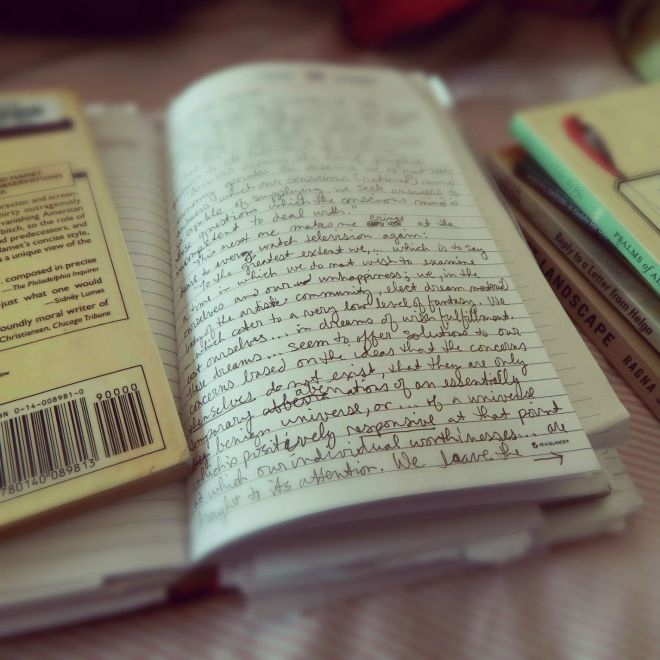
“The only way for human beings/is to choose”*

Instagram montage

It rained all day. A perfect day for reading books and drinking tea. By the opened window I listened to the rain and struggled with a dozen pages of one of Thomas Carlyle’s lectures. That afternoon I turned to Epstein for consolation. If he found it difficult to read Carlyle’s prose about the French Revolution, I may be in good company. Not that I should be compared to such a man of letters.

Many years ago I aspired to a career in letters. A local independent newspaper published my work. Then a few national and international literary journals picked up my work. Surrounded by writers who supported me and encouraged me to continue along that path, I composed a series of narrative non-fiction pieces. Sketches for a full-length book. Searching through this site’s archives, ten years ago (almost to the date), I teased these efforts. Writers had reviewed the three or four of the chapter sketches. An editor was sought to help finish the process. And publications were selected for submission to publication. And then. . .

These stories remain unpublished to date.

NOTES:
*The title of the post is a line from “In Rainy September” by Robert Bly.

Apparently I was so tired that I forgot to click the button marked “publish” on Sunday, September 11, 2022 at 9:48PM.

These were posted ten years ago:
Yes, it is true, September 7, 2012: https://coffeehousejunkie.net/2012/09/07/yes-it-is-true/
There is a story behind this photo, July, 10, 2012: https://coffeehousejunkie.net/2012/07/10/11796/
What hides behind this foggy morning photograph?, July 11, 2012: https://coffeehousejunkie.net/2012/07/11/11798/
Sisyphus tears down the mountain in a Chevy, July 12, 2012: https://coffeehousejunkie.net/2012/07/12/11802/
There’s a story… about double red doors…, September 5, 2012: https://coffeehousejunkie.net/2012/09/05/doublereddoors/

The Repository of Neglected Things, published

Why was The Repository of Neglected Things written, illustrated and published?

The idea of this published project began grudgingly.

First, some background. Old sketchbooks, from decades ago, resurfaced when I cleaned the garage a year or so ago. 

“What am I going to do with these?” I asked my wife. 

“Save them,” she answered. 

The cleaning plan was to throw away or sell garage items. Throwing away these large sketchbooks was not an option. And neither was selling them. The black cloth cover hardback sketchbooks varied in sizes. Most of them were nine inches wide by 12 inches high with 96 to 110 pages. Some were smaller. The smallest was four inches wide by six inches high. The largest was 11 inches wide by 14 inches high. 

A navy blue cloth cover hardback sketchbook made its way from the garage to my desk. It measured six inches wide by nine inches high. The little blue book was half full of sketches. Or half empty. As many as 40 blank pages. My wife encouraged me to fill the blue cloth sketchbook with drawings. My children asked me to make more drawings. One of the children requested I storyboard a comic book. Or picture book. Reluctant, I began a few pencil drawings. My wife bought me some brush markers. I added more sketches. Once the blue sketchbook was filled with drawings, I reviewed it. Should I return it to the garage with the other black sketchbooks?

Summer faded to Autumn. A plan formed around the recently filled blue sketchbook. A mission to show my children that they can write and illustrate their own stories, their own books. The goal. Showcase their work in a print publication. A comic book. With creativity and energy they pulled their stories together. They learned about the process of creating a story, illustrating, organizing pages and layout, and basic pre-press tasks. The stories from the children featured one about cats baking muffins and another of a mouse warrior. My contribution to the anthology was selected drawings from the blue sketchbook. The art inside spanned twenty years. A single narrative titled “The Little Blue Sketchbook” tied the drawings together.

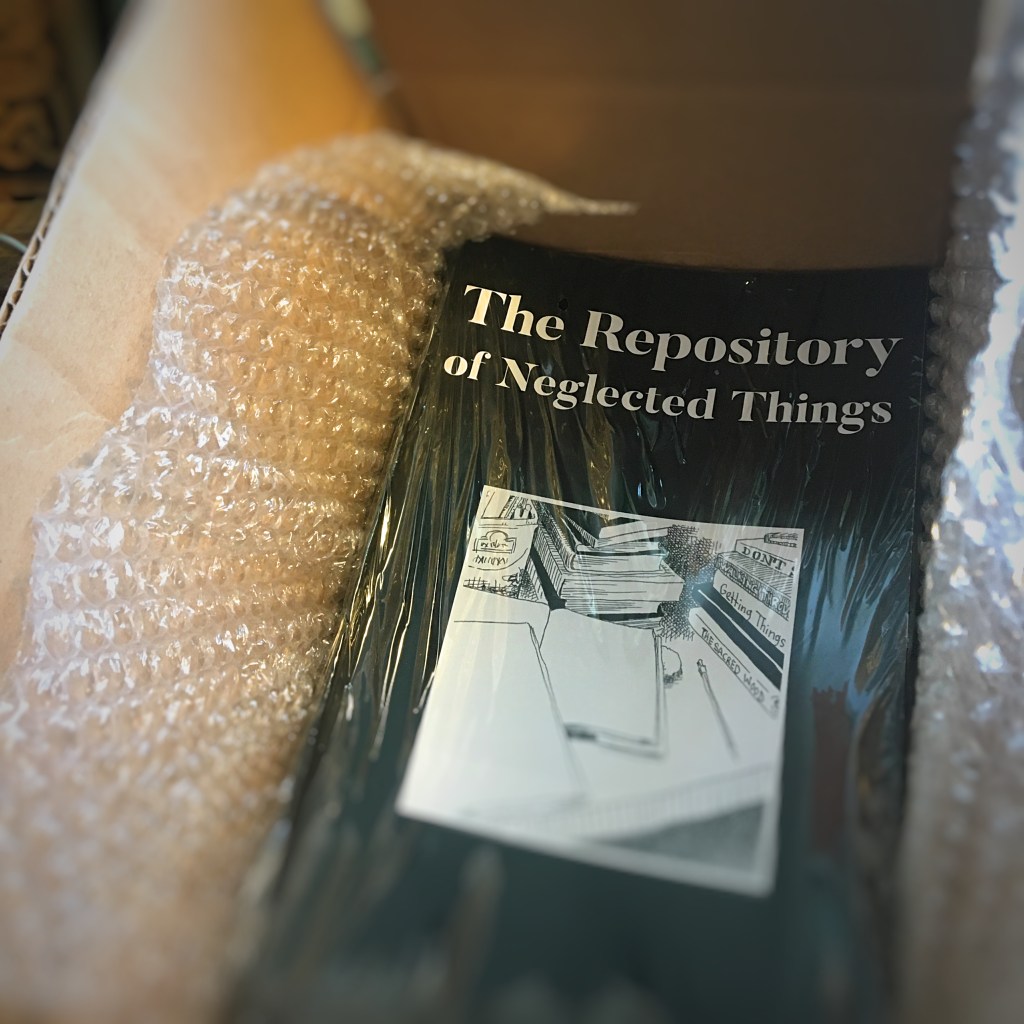
Finally, the publication The Repository of Neglected Things arrived. The children celebrated by flipping through the pages. They paused to examine their contributions. They read selections to each other. And then collected copies to send to friends and family. One child asked, “So, when do we publish the next edition?”

Comic book pages found

“What’s that?”
 
I turned to give the kidlinger a better view. 
 
“Did you draw all that?”
 
I nodded. 
 
Three years ago I rediscovered these 11 inch by 17 inch pages. Illustrated comic book pages hidden in a storage container. A gray Rubbermaid® Roughneck® storage tote of the 18 gallon variety. I stored art supplies, books, family keepsakes, manuscripts, and tools in dozens of similar totes. Living in a humid subtropic climate at the time, I did this to avoid water damage and mold ruining art and other supplies. Additionally, heavy duty polypropylene bags also prevent mold and water damage. To offer an added level of protection I used the technique of poly bagging art pages and then placing them within totes. When I moved across the country this also acted as a good way to pack.
 
However, that was not the case with these pages of art I discovered three years ago. Like an archeologist, I excavated those pages from a gray Rubbermaid®  tote. They were loose in the tote. Not poly bagged. Print samples of graphic design projects filled the tote as well. And also old newspapers and magazines. Either these publications featured something I wrote or something I designed.
 
In an effort to preserve the illustrated comic book pages, I found an old presentation book used for interviews. The Itoya Original Art Portfolio presentation books work the best. Good for professional presentation and storage.
 
During the holiday season I found one of the portfolio books with those illustrated comic book pages. Examined them again. This time one of the kidlingers was spying over my shoulder. 
 
“These are really good,” the kidlinger said. “Better than I can draw.”
 
“These are practice pages.” I said. Paused to let the kidlinger read the panels on the page. For a brief moment a wave of vulnerability washed over me. A child-like anxiety of examinations. The kind of fear I had when a school teacher reviewed my arithmetic work during class. Found an error and announced it so that all the class might hear. Why had I felt that way about my child reading this page? There were no objectionable elements to the story. Nor art. Nothing inappropriate for the kidlinger’s age. The moment passed.
 
“What language is this?” Kidlinger pointed at one of the panels on the page. 
 
“German.” I answered. “Deutsche.” 
 
The kidlinger hesitated. I considered translating the passage: Im Schatten sah ich. . .
 
“Lines from a German poem,” I said. “I added it to the story to help me remember the poem.”
 
Or to add texture to the short slice-of-life comic book story I composed. Sequential art as some have called it. A clever way of renaming comic book art.
 
I did not purchase my own comic book until I was in high school. An art teacher suggested that it may be a good way to study human anatomy. And it was. Exaggerated, dynamic anatomy. Superhero comic books were the only type sold at the local gas station on the way to school. The public library carried collections of Peanuts. But nothing like Superman or Batman. They did, however, carry the Classics Illustrated book series. Excalibur was the name of the comic book I bought at the gas station.
 
Though superhero comic books introduced me to sequential art, it was the slice-of-life stories that intrigued me. At the time, I had not heard of nor read American Splendor, Berlin, Cerebus, or Strangers in Paradise. But that was the direction I was headed creatively.
 
I probably added lines of German poetry to seem more sophisticated. To elevate comic book pages to sequential art.
 
“You wrote each of these stories, too?”
 
“Yes,” I answered the kidlinger. “Every one.”
 
I started to say something. To explain that these were practice stories and drawings. I wrote the script and illustrated the pages a decade ago. No. Maybe two. Each page, each panel pencilled and inked with crow quill and brush. It was practice for greater things.
 
My goal in those days was to publish a comic book or a childrens book. I did not know how. But the owner of a comic book store suggested I visit some comic book conventions. I did. And even booked a table on artists alley for a couple comic cons.
 
Artists alleys are a feature in nearly every comic con. The alleys feature artists and writers showing their work in hopes of securing a job with a major publisher. Or any publisher for that matter. Or trying to sell their own artwork. I met several artist and writers at these comic cons. And learned how hard I needed to work. Over time, I connected with writers and got a few independent projects. Some of them published. Most remained unpublished.
 
The kidlinger flipped through the entire portfolio. Read through several 2-page and 5-page stories.
 
“Nice,” said the kidlinger. An expression newly formed in the teenager’s mind to mean awesome or fantastic or good.
 
“What do you think?” I asked. 
 
“I don’t know,” said the kidlinger and ambled out of the room. 
 
I thought about that for awhile. What had the kidlinger found in looking through these pages? These artifacts? In a way, this portfolio is a childrens book for at least one child — my child — mein Kind. But these pages remain unpublished. Hidden in a black portfolio book. Even a fragment of a German poem remained hidden: Im Schatten sah ich/Ein Blümchen stehn. . .
 
I stumble through a translation:
 
In shadow I saw
a flower stand. . .
 
Or maybe:
 
In shade I saw
a flower grow. . . 
 
What is that? Goethe? Was I reading Goethe back then?
 
I will not deny the desire that someday I would like these early drawings and writings published. But why? Maybe my desire is misplaced. Maybe these pages should remain in the shadow. In the shade. They are practice pages after all.
 
And then I have discovered something else. I was reading Goethe when I illustrated those pages. A fragment from Goethe’s poem “Gefunden.” Or, in English, “Found.”

Strange Throwback Thursday

Comic Stroll 2013


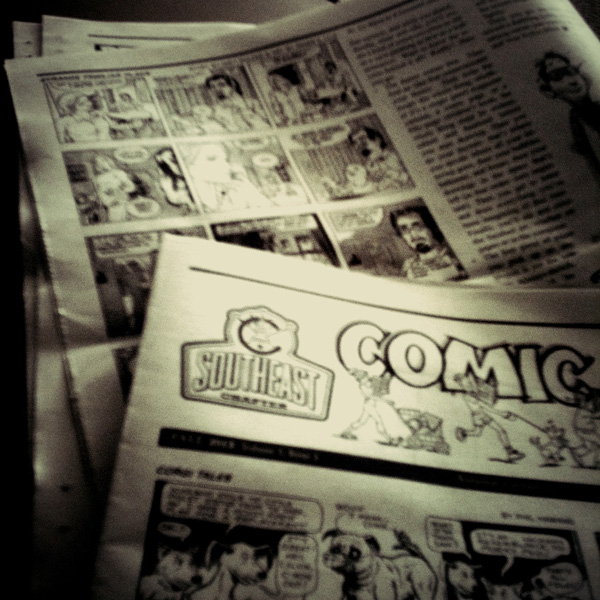
After nearly a six-year hiatus, I was excited to see a project that began with notes and sketches transform into a published comic strip. Even if it was a one-off. Even if I had to hand the responsibility of drawing each panel to someone else. It was done.

I had imagined that the creative non-fiction comic story I crafted would earn some interest. Maybe it would open a few doors to an audience. And allow me to write and illustrate. Even earn some money. Maybe I would quit my day job and provide for my household by doing something I loved. Telling stories. And drawing pictures.

That was five years ago.

A few weeks ago I found a box in the garage. It had several copies of a publication that printed my comic strip. I glanced over the pages and then placed them back into the box. I also found several books. Opened one book I remembered enjoying.

“What’s that?” asked one of the children.

“It’s a collection of comic strips.”

“Oh.”

I pulled a copy from the box and gave it to the child.

“There’s a story in there I wrote.” I said. “See if you can find it.”

The child took the copy of Comic Stroll and headed off to the couch in the living room.

I flipped through the pages of the book I had found. Read a few highlights.

Yeah, I resemble that, I thought to myself after reading a few lines at the end of the book. The author referenced a friend of his who gave up an art gig for a corporate job in order to provide for his family.

Yeah. I know what that is like.

How many comic pages might I have written and illustrated if I had. . . Well, what-ifs and might-have-beens are dangerous paths to pursue. What you did, great or small, is what matters.

Watching my progeny spend an afternoon reading comic strips I had a hand in creating was a pleasure.

NOTES:
Comic Stroll, a publication of the Southeast chapter of the National Cartoonist Society, featured a collection of previously unpublished comic strips. You can read the whole journey of what started in November 2005 as a couple drawings and became a creative non-fiction comic strip:
[1] Comics and Narrative Non-Fiction
[2] Comics and Narrative Non-Fiction Continued
[3] Narrative Non-Fiction Comics: part 3
[4] Narrative Non-Fiction Comics: part 4
[5] Narrative Non-Fiction Comics: part 5
[6] Narrative Non-Fiction Comics: UPDATE
[7] Narrative Non-Fiction Comics: UPDATE
[8] Strange Familiar Place comic series
[9] Strange Familiar Place returns
[10] The return of Strange Familiar Place to print

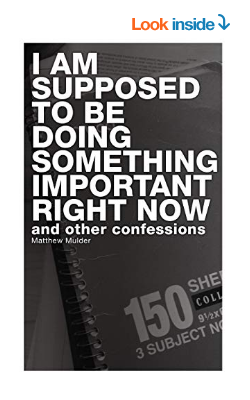
I am supposed to be doing something important right now

To post or not to post. To repeat old habits, or to start new ones.

That is how I concluded last week’s blog post. Further, I revealed that I wrote multiple drafts of the post. From a few different angles. And did not plan on posting them online.

However, a little bird told me it might be worth reading. So, in the tradition of chapbooks, I pulled together the scraps and assembled a small e-book.

The e-book runs 4000 words. Part one is a preface (basically, last week’s blog post). Part two contains five short chapters of blog extras. Consider it bonus material. Like 90s audio CD hidden tracks. Part three is a collection of twelve confessions.

The e-book is available FREE for those who have Kindle unlimited. Otherwise it is a meager $0.99 to download a copy.

Hope you enjoy it. If you like what you find, please leave a comment below or give it a starred review on Amazon. Much gratitude!

Patience – your writing finds the right audience

Have you ever written something that developed a life — even an audience — unexpected? The final chapter of a literary biography I read recently featured an introductory note that caught my attention. The author stated that of all the essays he had written during his long career the final essay of the book received the most attention. And the most requests for permission to reprint it in various publications.

Those were different days, I reflected. A time when permission was requested to reprint material an effort to share thoughtful writings. Rather than copy, paste, click and post.

In a very small way, a similar observance was made regarding a piece I wrote more than a decade ago.

This was back in the days before iPhones, Facebook, or Twitter. A time when SMS messaging — later texting — was a novelty that would be the most used mobile data service. But that was a couple years away.

A reader of my blog requested a review of a poem. I was suspicious of the request. Thought it might be a college student seeking someone to write his or her literature paper. I accepted the challenge.

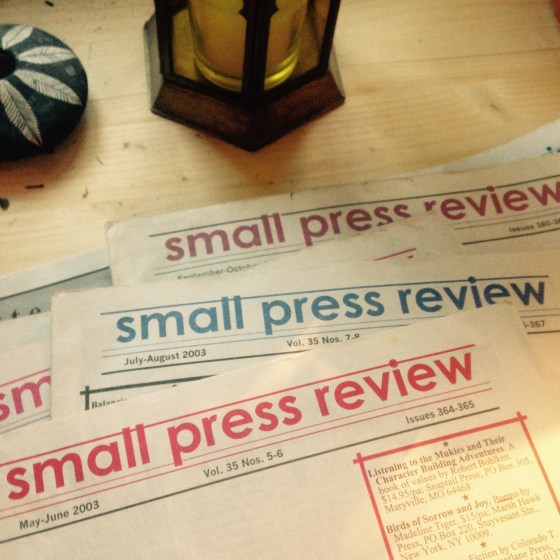
At the time, I was writing book reviews, essays, interviews and such. Mostly for local publications. But a few journals and magazines on the West Coast published some of my work. I reached out to Len Fulton of Small Press Review and asked if I could submit the poem review. He graciously agreed.

I wrote a review of Charles Simic’s poem “Old Soldier” in an esoteric manner that could not easily be passed off as a high school literature paper. I sent off the review for publication. And waited. Months went by. Issue after issue of Small Press Review arrived in the mail box. Impatient, I posted an abridged, clumsy version of the review on my blog. A month later I submitted it to editor, publisher, and friend Pasckie Pascua who published it in the September 2005 edition of The Indie. When the November-December 2005 issue of Small Press Review arrived I was surprised to see my review had — in fact — been published.

The review of Simic’s poem “Old Soldier” remains one of the most read posts on this blog. It is embarrassing to me for a couple reasons. One, the lack of virtue in my life. The selfish rush to be published. Patience is a virtue I am still learning to practice. Another reason for the embarrassment is that the online, perennial version of the review is a shadow of the original. The writing that appeared in the Small Press Review has never been released online. And maybe that is best for now.

The review of the poem is the final chapter of a book manuscript I finished. As of this writing it remains unpublished. But maybe one day it will greet an audience of its own. And maybe wander online as well.

A holiday podcast for Christmas Day

200612211149529[sqr]

There was a short story I wrote when I lived in my adopted hometown. I posted it last year.[1] An edited version of it was published in an indie newspaper ten years ago this month.[2] Hope you enjoy the story. Merry Christmas!


A Christmas story: Our home is waiting for us

by Matthew Mulder

DSCN3236[sqr-classic-dallas]

Westville Pub was busier than I thought for a Christmas Eve. It looked like we were not the only ones escaping the chilly, damp Appalachian December night. My small family arrived a little after eight in the evening to enjoy an energetic performance by Gypsy Bandwagon. There was only one booth available near the back that we quickly populated. The bar maid took my order for a pint of ale, chips and salsa and ginger ale.

Gypsy Bandwagon, self-described as genre-challenged, played lively Irish and Scottish jigs and reels, a bit of Bluegrass, classical piano solos and traditional gypsy pieces. Lead guitarist and vocalist shared singing chores with his wife, an accomplished violinist and keyboardist. The drummer,Uncle Biscuit, complemented his wife, a multi-instrumentalist, who played everything from the violin to the bass guitar. The band put on a free concert for the holiday crowd and brought gifts to give away to people in the Pub. With festive flare they gave away wrapped gifts if you owned a dog or claimed to be a Chicago Cubs fan or if you liked the last number they performed you got a free Gypsy Bandwagon CD.

Many traditional Christmas favorites filled their set list that pleased the crowd. A 16th century carol haunted me. I don’t even remember the name of it, but I imagined a New England tavern must have sounded much like that over two hundred years ago. I wondered about the first Christmas celebration.

Rome. December 25, 336 was the first recorded celebration of Christmas. Was there egg nog? Probably not. St. Francis of Assisi assembled one of the first Nativity scenes in Greccio, Italy on December 25, 1223. Nearly a thousand years between those two dates—and a lot of history. Leap forward nearly 600 hundred years, the well-known Christmas carol “Silent Night” was performed for the first time at the Church of Saint Nikolaus in Oberndorff, Austria on Christmas day in 1818. What will Christmas celebrations will be like in 100 years?

Thinking back to how I was raised by my parents, I suspect the notion of attending a gig in a pub with kids on Christmas Eve must seem odd—if not a bit disturbing. My oldest loved the whole experience. I am not sure if it was the ginger ale or the nachos or the bouncing on the booth seat to the music or the fact that he was up past his bed time. He seemed glad to be there. His baby brother fell asleep.

Uncle Biscuit came back and said hello during a quick intermission. He and his wife are good friends. It was getting late. After wishing him and his wife a Merry Christmas, we left.

It had begun to rain outside as the family gathered into the car. We drove home with the windshield lightly swishing away the rain droplets. When we arrived home my son said, “Our home is waiting for us.” I like that expression—home is waiting for us. The smell of fresh-cut poplar was sweet in the damp night air as we entered our waiting home.

Christmas morning. My family attended church. Coena Domini, or Eucharist, was celebrated. In low church fellowships it is called “the Lord’s Supper” or “communion.” Supper seems so common for a sacred “feast” on Sunday morning. Well, it was twelve ordinary guys that witnessed the death and resurrection of Jesus the Christ.

As the elements of Eucharist were distributed, I thought of Jesus — the babe born in Bethlehem. He reportedly fulfilled more than 300 prophesies. During the morning homily I read of ten of those prophesies. I found the fulfilled prophesies amazing. Ann Rice admitted to discovering similar facts while she researched her book, Christ the Lord: Out of Egypt.

What I did not find fascinating was the small plastic cup filled with grape juice and a crumb of broken Saltines. Is this not a Blessed Sacrament—as some Christians call it. I had a challenge finding anything sacred about a swallow of grape juice and a scrap of cracker. But these are simple reminders of a greater narrative.

Jeremy Huggins, author of literary nonfiction, posed the question, is there “any reason why I couldn’t go through the Communion line more than once?” Initially I responded: “When was the last time anyone ate a suggestion of bread and a swallow of wine and called it supper?”

For some reason I thought of the pale ale and nachos I had consumed the previous night at Westville Pub. Why is it that ale and nachos are not sacred reminders of the holy truth? Maybe that is a bit sacrilegious to be considered on Christmas—a holiday. Holiday means “a religious feast day.” A day like any other day recognized as sacred, hallowed, sanctified seems out-of-place in American culture.

As I held a swallow of grape juice and a scrap of cracker in my hands that Christmas morning, I remembered the night the Christ was betrayed. He shared his last meal of wine and bread with twelve ordinary, mostly nondescript guys who were being prepared to turn the world upside down. I identified with Jesus the Christ by taking the Eucharist. Am I more holy now than I was before? Does a day change its nature simply because it is recognized as sacred? I will leave those questions to the philosophers and theologians. “Our home is waiting for us,” my eldest child said on Christmas Eve. In more ways than the child realizes, that statement just might explain the reality of Christmas.

NOTES:
[1] A Christmas Story
[2] Recently Published Writings

Singular possessive or plural possessive

DSCN5313[sqr-basic-lofi]
Do people still diagram sentences?[1] Is writing still important in . . . read more ->

One week to go with the write 30 poems in 30 days challenge

DSCN5414[sqr-basic-lomo-lofi]

Do you write every day? Not typing or texting, but composing ideas and narratives and lines of poetry?

Earlier this month, I sat in a coffeehouse for almost an hour — during a late lunch break — and all I was able to produce was a 15-line sketch. A rough sketch, but the general motif and elements of the composition were represented.

The challenge of writing everyday is particularly rough when involved in knowledge work all day long. In my case, the mind is revved to creatively solve problems at the office and with internal and external clients. And for an hour in the afternoon, the part of the brain required to compose a few lines of poetry is so exhausted that the task is herculean.

Still. The discipline of exercise is part of the process. Keep training. Keep writing. Drink more coffee.

RELATED BLOG POSTS & NOTES:
[1] April – write 30 poems in 30 days
[2] April – National Poetry Month
[3] 30 poems in 30 days challenge
[4] Write 30 poems in 30 days: a challenge

A Christmas Story

200612211149529[sqr]

From the living room window, I see the full moon rising through the twinkling reflection of Christmas lights. At a glance, the moon might be mistaken for a street lamp. The play of lights off the window and through it remind me of something I read earlier this week: “Keep the ripple going.”[1] There is a short story I wrote that I have been sitting on for nearly a decade. An edited version of it was published in an indie newspaper.[2] Since it is Christmas and a full moon, it seems time to release the unedited/extended version of the text tonight before the clouds roll in and hide the moon. Hope you enjoy the short story. Merry Christmas!


A Christmas story: Our home is waiting for us

by Matthew Mulder

DSCN3236[sqr-classic-dallas]

Westville Pub was busier than I thought for a Christmas Eve. It looked like we were not the only ones escaping the chilly, damp Appalachian December night. My small family arrived a little after eight in the evening to enjoy an energetic performance by Gypsy Bandwagon. There was only one booth available near the back that we quickly populated. The bar maid took my order for a pint of ale, chips and salsa and ginger ale.

Gypsy Bandwagon, self-described as genre-challenged, played lively Irish and Scottish jigs and reels, a bit of Bluegrass, classical piano solos and traditional gypsy pieces. Lead guitarist and vocalist shared singing chores with his wife, an accomplished violinist and keyboardist. The drummer,Uncle Biscuit, complemented his wife, a multi-instrumentalist, who played everything from the violin to the bass guitar. The band put on a free concert for the holiday crowd and brought gifts to give away to people in the Pub. With festive flare they gave away wrapped gifts if you owned a dog or claimed to be a Chicago Cubs fan or if you liked the last number they performed you got a free Gypsy Bandwagon CD.

Many traditional Christmas favorites filled their set list that pleased the crowd. A 16th century carol haunted me. I don’t even remember the name of it, but I imagined a New England tavern must have sounded much like that over two hundred years ago. I wondered about the first Christmas celebration.

Rome December 25, 336 was the first recorded celebration of Christmas. Was there egg nog? Probably not. St. Francis of Assisi assembled one of the first Nativity scenes in Greccio, Italy on December 25, 1223. The well-known Christmas carol “Silent Night” was performed for the first time at the Church of Saint Nikolaus in Oberndorff, Austria on Christmas day in 1818. What will Christmas celebrations will be like in ten years? Or 100 years?

Thinking back to how I was reared up by my parents, I suspect the notion of attending a gig in a pub with kids on Christmas Eve must seem odd—if not a bit disturbing. My oldest loved the whole experience. I am not sure if it was the ginger ale or the nachos or the bouncing on the booth seat to the music or the fact that he was up past his bed time. He seemed glad to be there. His baby brother fell asleep.

Uncle Biscuit came back and said hello during a quick intermission. He and his wife are good friends and he is a local cartoonist and illustrator. It was getting late. After wishing him and his wife a Merry Christmas, we left.

It had begun to rain outside as the family gathered into the car. We drove home with the windshield lightly swishing away the rain droplets. When we arrived home my son said, “Our home is waiting for us.” I like that expression—home is waiting for us. The smell of fresh-cut poplar was sweet in the damp night air as we entered our waiting home.

Christmas morning. My family attended church. Coena Domini, or Eucharist, was celebrated. In a non-denominational church they simply call it “Lord’s Supper.” Supper seems so common for a sacred “feast” on Sunday morning. Well, it was twelve ordinary guys that witnessed the death and resurrection of Jesus the Christ.

As the elements of Eucharist were distributed, I thought of Jesus — the babe born in Bethlehem. He reportedly fulfilled more than 300 prophesies. During the morning service I read of ten of those prophesies. I am not a theologian, but I found the fulfilled prophesies amazing. I am not a mathematician either, but the probability factor is equally fascinating. Ann Rice admitted to discovering similar facts while she researched her book, Christ the Lord: Out of Egypt.

What I did not find fascinating was the small plastic cup filled with grape juice and a crumb of broken Saltines. Is this not a Blessed Sacrament—as some Christians call it. I had a challenge finding anything sacred about a swallow of grape juice and a scrap of cracker. But these are simple reminders of a greater narrative. Nothing wrong with common things.

Jeremy Huggins posed the question, is there “any reason why I couldn’t go through the Communion line more than once?” Initially I responded: “When was the last time anyone ate a suggestion of bread and a swallow of wine and called it supper?”

I wonder if American Christians embrace an ascetic view of communion because they live an epicurean lifestyle. Should followers of Christ not seek the highest pleasure—desiring God? Let us feast Deo favente (with God’s favor).

By practice, the fellowship I attend also observes the Passover Supper each year as part of Passion Week. The elements of the Seder Dinner (Maror: bitter herbs-horseradish, Karpas: vegetable-parsley, Chazeret: bitter vegetable-lettuce, Charoset: apple, nut, spice and wine mixture, Zeroa: shankbone-kosher lamb and Beitzah: egg) are symbolic and common. Likewise, bread and wine are common food items. Still a supper is a supper, not an appetizer.

For some reason I thought of the pale ale and nachos I had consumed the previous night at Westville Pub. Why is it that ale and nachos are not sacred reminders of the holy truth? Maybe that is a bit sacrilegious to be considered on Christmas—a holiday. “Holiday,” from an Old English word “hligdæg,” means “a religious feast day.” Why a holy day? The Middle English word “holi” has Old High German origins from the word “heilag” meaning “sacred” which has Gothic roots meaning “hallow, sanctified” which further has Latin sources in the word “sanctus.” A day like any other day recognized as sacred, hallowed, sanctified seems out-of-place in American culture.

As I held a swallow of grape juice and a scrap of cracker in my hands that Christmas morning, I remembered the night the Christ was betrayed. He shared his last meal of wine and bread with twelve ordinary, mostly nondescript guys who were being prepared to turn the world upside down. I identified with Jesus the Christ by taking the Eucharist. Am I more holy now than I was before? Does a day change its nature simply because it is recognized as sacred? I will leave those questions to the philosophers and theologians. “Our home is waiting for us,” my eldest child said on Christmas Eve. In more ways than the child realizes, that statement just might explain the reality of Christmas.


NOTES:
[1] Who touched your heart forever moment year by Melissa G Wilson
[2] Recently Published Writings

Publication of “Mortal Coil”

DSCN3939[sqr-tilt-dallas]

Left of the Lake published “Mortal Coil” in the August issue. It is a short story I wrote. A really short story. And now it is almost September.

A prepublication notice was posted. Then I forgot to mention where you can get a copy of the magazine to read the story.

The publisher mailed a copy. I shared it with friends in writers group.

“This is so neat. Congratulations, Matt,” said one of the writers of the Village Ink Writers Group. After looking through the printed copy she pointed at the author bio photo and asked, “Is that you?”
“Yeah,” I said. “That photo was taken a couple years ago… before I moved.”
“You’ve lost weight.”
I laughed. “Poverty has its benefits.”

I failed to consider that friends and fans — who I do not get see me face-to-face every week — may like to read “Mortal Coil.” I will do my best to remedy that.

In the mean time, I continue to collect rejection letters from other publishers regarding other submitted work. Cheers!

I have not weeded, I have not written

DSCN3925[sqr-tilt-dallas]

Two authors provided me with food for thought during the last week or so. “Courting the Gargoyle”1 by Sheryl Monks explores the dichotomy many writers experience.

“I’ve taken to describing myself as part cheerleader, part gargoyle. The cheerleader, . . .  is a powerful avatar, . . . . hopeful, peace-broker . . . .  She sees the world democratically; it’s flawed, . . . but it’s not without beauty. . . . the gargoyle is fragile. The gargoyle sets the bar too high, and as a result, the world and the people in it disappoint.”

While you digest that idea, Ann E. Michael confesses that she is too busy to write. Unlike many writers who become jaded and obsessed with lack of discipline and failure, she is hopeful.

“I have not been weeding, as I have not been writing. Other priorities are claiming the be-here-now of my life; but I’m happy to find that the garden, and my writing life, can be sustained through other things and returned to at better times.”2

I confess, I have not weeded the garden either. Yet, providentially, the tomatoes, beans and chard have grown in abundance. I am part gargoyle. The part that never sees the light of social media. I have not written consistently (or as consistently as I planned. . . the gargoyle again.) Midimike commented that there will be time “to write about all those days when you were too busy to write!”3 I am part cheerleader. The brief smile that flickers across the light of social media.

NOTES:
[1] “Courting the Gargoyle” by Sheryl Monks, August 10, 2015. http://changesevenmag.com/portfolio/courting-the-gargoyle/
[2] “Too busy to write (sigh)” by Ann E. Michael, August 13, 2015. https://annemichael.wordpress.com/2015/08/13/too-busy-to-write-sigh/
[3] https://coffeehousejunkie.net/2015/07/22/the-purpose-of-drawing/#comment-4566

Forthcoming publication – Mortal Coil


DSCN3549[sqr-tilt-dallas]

Received notification earlier this month that a piece I wrote earned second place in a writing contest. It will be published in the August 2015 issue.

The contest judge is a faculty member at Columbia College Chicago. So, the acceptance of the prose piece submitted seems to have some merit. Or at least that is what I try to convince myself, because all month I have received notification of other submissions that have all been rejected.

Much gratitude goes to the members of the writers group that meets at the Graham Public Library who saw the first handwritten draft of the story. Their support has been amazing. And special thanks to novelist Justin Grimbol, for encouraging me in the craft of fiction.

Book bundles available at the book fair


DSCN3144web

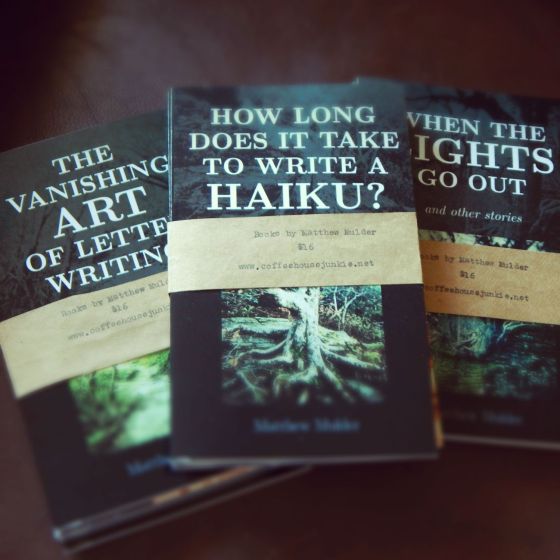
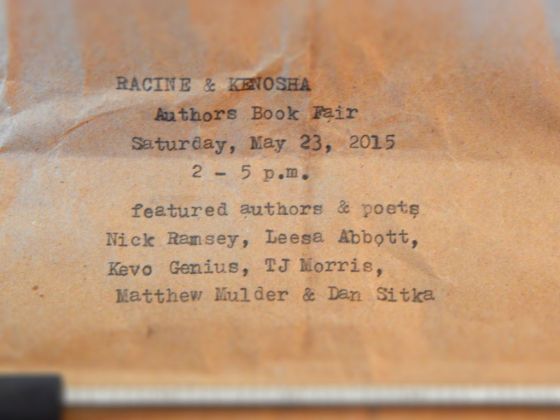
Who doesn’t like a deal? This weekend only at the Racine & Kenosha Authors Book Fair (Saturday, May 23, 2015, 2-5 p.m., Rhode Center for The Arts), you can purchase copies of my books for special book fair price: four books for $16. Limited quantities are available. So come early. See you there.

Almost two weeks and counting…

DSCN2804-tiltshiftThe Rhode Center for The Arts in Kenosha, WI hosts an author reading of local poets and writers (including myself) on May 23, 2015.

I will have copies of How Long Does it Take to Write a Haiku?, The Vanishing Art of Letter Writing, Late Night Writing and other books for sale.

For invitation to the event, please contact me for more details.

Typewriter poetry and blogging

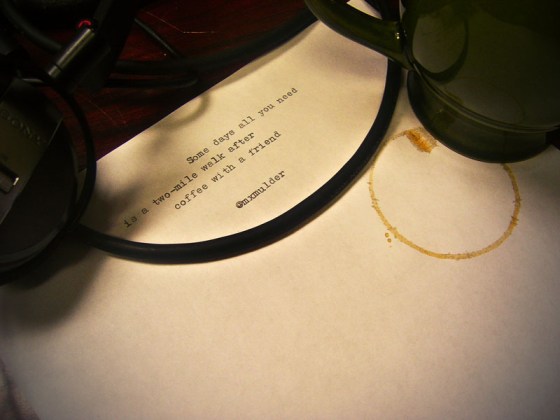
Some days all you need
A poem for a friend composed on a manual typewriter

At least five years ago, an old beat up manual typewriter provided a platform to compose poetry and other writings.1 It was an effort to return to an intentional practice of crafting poetry and prose without distraction of disruptive media.

For years and years, a notebook, journal or sketchbook was never far from reach. But one night after a long night of poetry and music at Beanstreets followed by an even longer time of coffee and conversation at Old Europe, a friend convinced me to try blogging.

Photo courtesy of @mxmulder
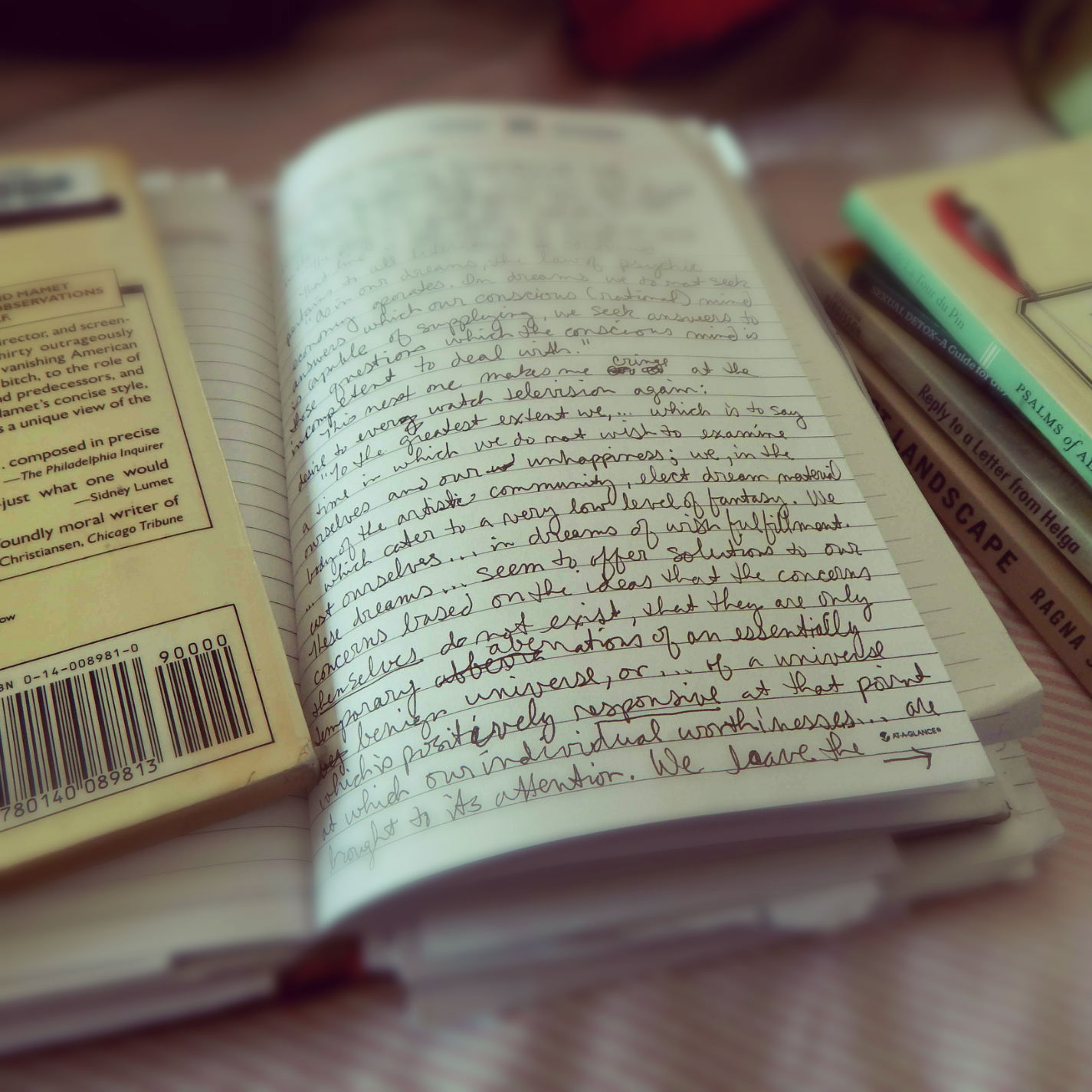
Sample journal page of poetry

The immediate response to blogging was infections.2 Connecting with people all over the country, networking, sharing and being part of an active digital community was exciting. The practice of writing allowed me to hone the craft of creative writing and exposed me to other writers across the country. One of those bloggers actually showed up at a poetry gig I did. She was on a cross-country trip to visit friends and wanted to visit in real life.

Over time, I noticed that my practice of writing notes, daily sketches and other activities had all but disappeared. Relying on keyboards, display screens, hard drives and servers presented became a crutch. My writing drafts and sketches appeared deceptively crisp and final in neatly formatted text documents and web blog interface windows.

So, I pulled the plug. Returned to handwriting and typing as practice.3 Some friends and fellow poets saw a few samples of typewritten work and suggested I post it on my blog. It was a novelty. A curiosity. So, I did.

One of the first photographs of a poem I composed on a typewriter was written for a friend. It was posted about this time of year — in 2011.4 A few days later I followed up with another poem5 that was later read at poetry event.

I do not claim to be the first person to post an image of a poem typed on a manual typewriter. But I noticed a trend in that direction about a year after posting those images of poem sketches.6 Not sure exactly if I started the trend. Probably did not. Maybe other like-minded individuals who sought to return an organic practice of handwriting and typing as a mode of composing their visions and ideas.

Here is to a five year anniversary of analog writing.

NOTES:
[1] In truth, I composed poems on an electric typewriter prior to that. Did it for decades. Did not own a personal computer until… well, that is another story.
[2] That was when there were a mere couple million web blogs in the world. Now, there are some platforms, like Tumblr, boasting 100 million blogs. The blogosphere has become quite congested.
[3] Examples of some the 30 poems in 30 days journal posts with photos: here, here and here.
[4] April 1, 2011, blog post.
[5] Poem: “Never Look A Doughnut Dealer in the Eyes”
[6] Examples include Typewriter Poetry, Remington Typewriter Poetry, and the most popular is Tyler Knott (though his web page has an archive going back to 2003 (which is odd because he uses Tumblr as a platform and Tumblr was launched in early 2007… maybe he migrated his content from some other source to Tumblr… but I digress) the posted images do not begin until 2012 (unless I am mistaken).

Tonight: Village Ink Creative Writers Guild open house

20150403-151950.jpg

The Village Ink Creative Writers Guild has an open house tonight at 6:30 p.m.

What to expect tonight? Expect puppy chow (yes, puppy chow) and cupcakes and maybe peanuts. Expect poetry and prose. Expect good stories by good writers. Expect to have a great time with local writers.

The Village Ink Creative Writers Guild authors plan to share recent works like “Animal Hospital” (children’s literature), “Disturbed” (fiction), “Popular Fiction” (fiction) “Genie-soul” (non-fiction) and selected poetry and prose.

The evening will conclude with a question and answer session for those who have questions about the guild and the craft of writing.

Hope to see you all there!

Graham Public Library, Union Grove, Wisconsin
April 7, 2015, 6:30 pm

FREE to the public. Light refreshments will be served.

Tomorrow: Village Ink Creative Writers Guild open house

20150403-151950.jpg

You are invited to the Village Ink Creative Writers Guild authors reading open house at

Graham Public Library
Union Grove, Wisconsin
Tuesday, April 7, 2015
6:30 pm

Five local writers present selections of their work. The Village Ink Creative Writers Guild meets every Tuesday at the Graham Public Library and is open to writers of all genres and disciplines.

The open house is a great way to celebrate National Poetry month and the event will highlight the last six months of creative energy and writing endeavors.

Selected works include children’s literature, fiction, poetry and creative non-fiction.

For more details, please leave a comment. Thanks!

The open house is FREE to the public. Light refreshments will be served.

Next week: authors reading open house

20150403-151950.jpg

You are invited to the Village Ink Creative Writers Guild authors reading open house at

Graham Public Library
Union Grove, Wisconsin
Tuesday, April 7, 2015
6:30 pm

Five local writers (including myself) present selections of their work. The Village Ink Creative Writers Guild meets every Tuesday at the Graham Public Library and is open to writers of all genres and disciplines. The open house is a great way to celebrate National Poetry month and the event will highlight the last six months of creative energy and writing endeavors. Selected works include children’s literature, fiction, poetry and creative non-fiction.

For more details, please leave a comment. Thanks!

The open house is FREE to the public. Light refreshments will be served.

Rule number eight

“Every word on your blog is a word not in your book.”

Sherman Alexie

The Village Ink Writer’s Group

Village Ink Writer’s Group meets tonight, Tuesday, 6:30PM. I’m leading group tonight. Hope to see you there! http://ow.ly/IqlTW

Behind the camera

DSCN2322[square-tilt-dallas-frame]

A concrete slab harvested from a demolished city building defends Pershing Park from the frozen Lake Michigan waves. It is large — the size of a small sedan — and surrounded by smaller rubble. Rebar and concrete and ice mix into a violent Jackson Pollack sketch as waves thunder into the shoreline.

The temperature outside is in the single digits — lower with the windchill. In the small sedan, the heater is not working. Or not well. The driver’s toes — numb from the cold — curl and uncurl. The driver is trying to capture an image — a photograph — of the spray from the waves when they hit the shoreline and shoot twenty feet into the air.

The visit to the public library introduced the driver to books by E. L. Doctorow, Wendell Berry and Alberto Manguel and a book on the history of time by Oxford Press. Timing the waves as they advance on the shoreline creates an illusion of distance. Patiently the driver composes a few more images.

The icy air advances deeper into epidermis. Reluctantly the driver places the lens cap on the camera and stows it in a black bag next to the library books.

Best reads of 2014 (or what I found in my notebook)

BestReads2014_DSCN2263When I read and write, I connect dots. Maybe you do too. Earlier this month, I noticed — and commented on — a Facebook post that linked to an article on how writing thoughts, ideas and quotes into notebooks makes one smarter. That article reminded me of how commonplace books house many notes and quotes from books read. [Link to article on commonplace books] The art of notations in commonplace books has been a practice of mine for decades. Whether it makes me smarter is yet to be evident.

Connecting some dots. Last week I came across a tweet that read:

“Ranking artists and making lists is a dead culture’s version intellectualism.”
@marcmaron

Considering this originated on twitter, I am inclined to disregard it. Yet, oddly, it resonates with me on some levels. Maybe it is because of the blogs I follow that list and present authors’s reading statistics (examples here and here).

Connecting dots. Over a year ago, sitting in front of the large windows of the Pack Library, I pondered the best of lists of 2013. My response is documented in this post. In brief, I listed my best books I read during the year — that were not printed in 2013.

Should I do a list for this year, 2014? The Seattle Times published their 2014 list. The Economist presented their austere list of best reads of 2014. Of course, the New York Times presented there top books of the year as well as a number of other publishers and blogs that try to capitalize on the posting their lists in time for holiday purchasing.  

For 2014, allow me to open up the pages of my commonplace book — a thick red daily reminder journal used for both a calendar of events and appointments and day book — and share with you some of the notes and quotes found therein. Starting in March there is an entry on the following book:

Nobel Lecture: Czeslaw Milosz by Czeslaw Milosz

Found a hardcover, bilingual edition at the public library. That edition appears to be out of print based on internet searches. (If you find a first edition, hardcover edition please let me know.) Here are a line I wrote in my commonplace book/day journal:

“Two attributes of the poet, avidity of the eye and desire to describe that which he sees.”

And this one:

“In the minds of modern illiterates, however, who know how to read and write and even teach in schools and at universities, history is present but blurred, in a state of strange confusion. Moliére becomes a contemporary of Napoleon.”

Crediting Poetry: The Nobel Lecture by Seamus Heaney

“Ahistorical, pre-sexual, in suspension between the archaic and the modern, we were as susceptible and impressionable as the drinking water that stood in a bucket in our scullery: every time a passing train made the earth shake, the surface of the water used to ripple delicately, concentrically, and in utter silence.”

This Year You Write Your Novel by Walter Mosley

“The first thing you have to know about writing is that it is something you must do every day — every morning or every evening, whatever time it is that you have.”

And…

“The process… is… a journey by boat…. If you get distracted or allow yourself to drift, you will never make it to the destination…. The journey is your narrative.”

A Region Not Home: Reflections from Exile by James Alan McPherson

From the opening paragraph, this book drew me in:

“In 1974,… I lived in San Francisco, California. My public reason for leaving the East and going there was that my wife had been admitted to the San Francisco Medical Center School of Nursing, but my private reason for going was that San Francisco would be a very good place for working and walking.”

What other reason is there to move, right? Here is another selection:

“Friendships grounded in mutual alienation and self-consciously geared to the perception of others are seldom truly tested. They lack an organic relationship to a common landscape, a common or ‘normal’ basis for the evolution of trust and mutual interest.”

More along the theme as well as reference to Ralph Ellison:

“It was Aristotle who thought the most deeply about friendship as a moral virtue. He [referring to Ralph Ellison] distinguished between friendships grounded in pleasure and utility, which friendships last as long as pleasure and usefulness last. These two grounds of friendship are common. For Aristotle, the best of all grounds for friendship was what he termed ‘perfected friendship.’ This degree of friendship obtains when one person wants for the other what is good for him simply because it is good for him. He believed that only people with comparable virtues could sustain this kind of friendship. Aristotle did not mean equality of virtue; he meant proportionate virtue. He meant that each is prepared to render to the other what the other deserved.”

Somewhere More Holy: Stories from a Bewildered Father, Stumbling Husband, Reluctant Handyman, and Prodigal Son by Tony Woodlief

There are so many selections written in my journal that I turned it into a book review and later featured it in a podcast. Listen to it here.

One for the Rose by Philip Levine

This is another jewel found in the public library. Again, it appears out of print according to online retailers and first editions seem to be rare. (Contact me if you find a first printing of this one.) Here are two excerpts of poems from this collection of poems:

“I was born in Lucerne
I faced the longest night
of my life with tight fists and closed eyes
beside a woman of independence and courage
Who sang the peasant songs of her region.”

And

“and I could sit for a moment
remembering what it was
to rise slowly to a world
that seemed at peace on the long
Sunday mornings of lonely first manhood
when I knew nothing
except there was no work that day”

Scrambled Eggs & Whiskey: Poems, 1991-1995 by Hayden Carruth

This book drew a lot of ink into my daily journal. Here are two samples I wrote during the summer:

“and I still cannot believe you wouldn’t
give me a job when I needed one so badly”

And

“Old men converse across the abyss of time
on a hot evening in elusive light—”

Okay, one more…

“Somehow his eyes get lost
in the words and the snow”

Pigafetta Is My Wife by Joe Hall

This is a book I struggled with. A lot. Eventually it won me over and — ahem — became my wife. You will have to read it to understand the allusion. Here is a couple lines to entice you:

“I need to stop imagining that
some straight lines connect us”

Finding the Islands by W. S. Merwin

At some point in autumn, I realized I had written down some many lines from this book I practically transcribed the book into my journal. One day, during the noon meal I quoted a few lines from the book. Everyone at the table went silent. Here is an excerpt that still haunts me:

“How time disappears
while we live under
the big tree”

The Name and Nature of Poetry: and Other Selected Prose by A. E. Housman

What can I say about this book? Well, read some of the things I copied into a commonplace book:

“We should beware of treating the word poetry as chemists have treated the word salt…. If we apply the word poetry to an object which does not resemble, either in form or content, anything which has heretofore been so called, not only are we maltreating and corrupting language, but we may be guilty of disrespect and blasphemy.”

And

“Man had ceased to live from the depths of his nature; he occupied himself for choice with thoughts which do not range beyond the sphere of the understanding; he lighted the candles and drew down the blind to shut out that patroness of poets, the moon.”

There are more notes and books referenced in my commonplace book/day journal that are not included. May this inspire you to connect dots, make notes and start a commonplace book of your own.

How To Keep Writing During the Holidays

For writers (and bourbon lovers) this is a good article on how to stay focused at the task of writing.

via How To Keep Writing During the Holidays.