Wordfest — Voices of the City

Asheville Wordfest 2012 presents Voices of the City and features several local poets. I’m honored listed among the following local poets: Katherine Soniat, DeWayne Barton, Ronald Reginald King, Matthew Mulder and Roberto Hess.

Three ways for authors to promote their new book

This is obvious, but essential. Connecting with a local bookseller is vital to promoting your book. Most booksellers see your book title listed in their wholesale catalogs. All you need to do is remind them it’s there and then see if they’ll host an event. Be sure to contact the bookstore’s event coordinator, not the store’s book buyer. The PR  & Events Coordinator schedules store events like readings and book signings and is the best point of contact for a newly published author.

Consider non-bookstore venues. Schools, public libraries, or other venues may have suitable audiences for your book title. Don’t just assume that your audience only buys books at Barnes & Noble. Libraries are great places to read. I’ve read in various locations including a tavern, café, ballroom, art studio, church and several other places. One author I know had a reading at a chocolate shop. Be creative with your events.

Social media sites like Twitter, Facebook, etc. are great tools to promote your book. If you don’t have an account, you’re already behind. Be authentic and approachable on these sites. If you sound like you’re a pushy salesperson, you’ll lose your audience. Share with your social media audience the same way you approach your book reading audience. Make converts from social media followers to book buyers.

Upcoming reading at Asheville Wordfest 2012

Next week I’ve been invited to read some of my poems at one of the Asheville Wordfest 2012 events. The schedule is still fluid. So, you’ll have to check the official Wordfest website for the schedule details. Suffice it to say, I am extremely humbled and honored to read with great local and global poets.

Two reasons why I quit Tumblr

What is Tumblr? Besides being a highly addictive micro-blogging platform, [1] it was the place I did most of my blogging during the last few years. That is, until a few weeks ago. Two primary reasons why I deep-sixed my Tumblr accounts: simplistic functionality and superficiality.

Those familiar with Tumblr know the distraction of the endless expanse of images that populate the majority of these micro-blogs. Tumblr subscribes to the lowest common denominator of web log functionality to allow for users to post photos, videos, audio & text. The Tumblr interface allows users with absolutely no HTML experience and no blogging experience to post a menagerie of online content without having to really think about it. Add to the mindless uploading or reblogging of content is the liking system. If you “like” a blog post viewed somewhere in the Tumblr stream of people you are following, then you click the heart icon. The system is reciprocated by other users in a virtual validation and comparison of or by other Tumblr users. What makes this system clumsy and superficial is that there is no real communication between users. In a way, it’s like an individual person in a large airport terminal with all the televisions droning on and on. It’s an extremely lonely experience.

The “follow” feature, like Twitter, allows users to track your posts — and you may follow in return. Curious as I am, I often clicked on Tumblr profiles to find out who is following my Tumblr account. Like Twitter, a lot of my account’s followers were users seeking to promote something or looking for personal validation and/or competition by earning return follows (it is a common practice on Twitter to earn more followers in order to expand audience reach or to just boasting rights to having thousands of tweeple following your tweets). Some people prefer Tumblr because it easily integrates with social media sites [2] making it more of a network tool than a blogging platform. When Tumblr was first launched it was very simple to aggregate your Tumblr content to Facebook, Twitter, and other social media outlets. But now most blogging platforms allow that too. Most of the followers to my Tumblr account didn’t connect or even communicate with me. They just “like” something I post and then “follow” my Tumblr account. It’s an empty, hollow interaction if not essentially dehumanizing.

Another issue I had with Tumblr is that the platform really doesn’t work well for long-form blog entries. There are exceptions, [3] but on the whole, most Tumblr users are there for photos or videos or reblogging someone’s photos and videos. As someone who enjoys reading and stimulating conversation, I became very aware of how my thinking was changing as I consumed the endless Tumblr stream of images. One night I speculated that some users must spend all day on Tumblr. There is a schedule feature on Tumblr that allows users to place posts in a queue to be published later, but the time investment to post photos seems vapid. Occasionally, I’d come across an intelligent quote or text-post and “like” it or even “reblog” it. I discovered, to my embarrassment, that not all quotes I reblogged or liked were accurate and stopped the practice.

Increasingly, I was disturbed that the lack of exchange of ideas was altering the way I think as I succumbed to an avalanche of images falling from the blue Tumblr interface screen. One blogger noted that someone said Tumblr is an intellectual version of Twitter, [4] and further noted correctly that most Tumblr users post photos. How is that intellectual? I must confess, when I began to use Tumblr as a blogging platform I posted a lot of text pieces. It was an easy platform to post my writings, art work and photography. I liked the ease that it offered. But I got caught in the cycle of seeking validation of posting content simply to earn “likes” from “followers.” So, like an addict, I’d post more content — images that I didn’t create, but I liked (and sometimes “liked”) or inspired or informed me. But there was little if any engagement with other Tumblr users. Facebook and Twitter offered more discussion and conversation than Tumblr. It felt like a completely self-centered arena that offered nothing but consumption of content with no way to seek the best in others. I was not growing or learning from my Tumblr experience. I wasn’t meeting new people and exchanging ideas.

For me, quitting Tumblr comes down to this. An online community cannot grow and flourish if the lowest common denominator is a micro-blogging platform for web-illiterate users who reblog each others photos with silent alacrity.

NOTES: [1] Not that you need to be introduced to the crack cocaine of blogging — Smashing Magazine provides A Complete Guide To Tumblr [2] Read Compete’s report “Tumblr vs. WordPress vs. Blogger: Fight!” where it states that Tumblr functions more like a social network. . .” and “reduces barriers to publishing content .” [3] Longreads collects long-form online content from various publications [4] Olsen Jay Nelson

How to capturing abstract ideas in a book cover design

How do you capture an abstract thought for a book cover design? That’s the question one person left in the comments section to Judging a book by its cover.
That is a challenge. A lot of abstract ideas — like love, grief, joy, freedom, etc. — have emotional and psychological weight. Photography is an easy tool to use in conveying physical responses to abstract thoughts. Photos illustrating love or grief become cliché. For example: how many books can you find at a local book seller on the topic of grief of a loved one that includes sun bursting through voluminous clouds? There are reasons for a majority of the bereavement books have similar titles — primarily marketing. Readers looking for books on how to cope with grief in a book store find themselves staring at a shelves of cloud cover books. So how does a graphic designer create a cover that competes with all the cloud-covered-grief-books?

Here are two other tools to consider: color and shape.

Color

Color psychology informs me what colors might work best to address a book on the topic of grief, freedom or spirituality. The challenge arises frequently — due to an enormous amount of books published every year — that most books on the topic of grief utilize the same color scheme or photographs of a path leading through a forest with a bright patch of light at the end or the ever-present sun breaking through the clouds. So I turn to color psychology as a tool to design a book cover dealing with the abstract concepts of grief, joy, love, etc. There has been a lot of research in this field to learn from. For example, blue (depending on the shade or tint) offers a feeling of peace, tranquility, confident, and as reliable as the sky and ocean. But blue can also be cold and corporate (again, depending on the shade or tint). Interestingly, brown can express reliable and authenticity.

Shapes

Recently, I’ve turned to the psychology of shapes and patterns as a way to define abstract ideas like endurance, peace or joy. According to research, there are three main categories of shapes: geometric, organic and abstract. Other distinctions remind me of primary school including: circles, squares, triangles, spirals, and more. Also, the orientation of the shape is essential — horizontal and vertical. Squares and rectangles are common but express peace, stability, conformity or other abstract concepts. For example, a horizontal rectangle expresses confidence in much the same manner as the color blue. Whereas a spiral shape my best represent grief as it expresses the idea of death, life and transformation.

As I share the psychology of color and shape with authors with whom I am designing their book covers, they often need to be educated on the visual vocabulary of these ideas. Most of the authors understand the premise of how color, shapes and patterns express the content of their book. Additionally, most of the authors prefer a photographic cover design. This is a bit off in my mind, because what is a photograph but a composition of colors and shapes? Is there a lack of visual literacy in our culture? Or is the graphic design community a cloistered cult of artists that do not share secrets with the outside world?

As I design book covers, these are the tools I fall back on consistently: color and shapes.

Life is lived as a messy first draft

How do you explain a poem without revealing its mystery? I thought about that question this weekend after a private poetry reading session. A few poets gathered under a full moon to read new work….

[read more]

UPDATE: This blog post is available as part of an audio podcast.

Listen now:

Or listen on:
PodOmatic: coffeehousejunkie.podomatic.com
SoundCloud: soundcloud.com/coffeehousejunkie

E-book: This blog post will be featured in a forthcoming e-book. More details coming soon.

Asheville Wordfest Kickstarter campaign begins

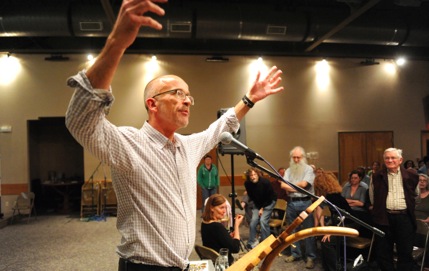
Mark Doty, Asheville Wordfest 2010

The Asheville Wordfest Director, Laura Hope-Gill, announced last weekend that the Asheville Wordfest 2012 began a Kickstarter campaign to help fund the poetry festival. Wordfest celebrates its fifth year of providing a space for poets of various cultures and contexts to share their work with enthusiastic supporters of poetry.

This year’s poetry festival features many local poetry luminaries as well as notable national and international poets. Various events are scheduled at the Grateful Steps Foundation Bookshop, the Altamont Theater and other locations in Asheville, NC  between May 2-6, 2012.

Here’s an excerpt from an e-newsletter that was sent last Friday night regarding the Asheville Wordfest 2012 Kickstarter campaign:

Please kindly help Wordfest by donating to the Kickstarter campaign through Poetry Month: Asheville Wordfest 2012 Kickstarter campaign.

Asheville Wordfest 2012: HOME: Place and Planet takes place from Wednesday May 2 through Saturday May 5, 2012. North Carolina Humanities Council generously funds the festival in part, and we need your help to really bring it to life.

Along with our stellar guest poets, Wordfest 2012 aims to present as many local voices as is possible within the scope of a few days. Because our local voices resonate with the global whole, we welcome the following guest poets: Choctaw scholar, author and poet LeAnne Howe, Guggenheim and NEA Fellow Arthur Sze; Egyptian-American poet Matthew Shenoda; American Book Award Winner Allison Adelle Hedge Coke of Cherokee and Huron Nations. Learn about these stellar poets at www.ashevillewordfest.com. Thank you for your help in promoting multiculturalism and community through poetry.

Write 30 poems in 30 days: a challenge

During the summer of 2010, I took up the challenge to write 30 poems in 30 days with two goals in mind:

  1. generate new material and
  2. unclutter my mind.

Yesterday I began a new cycle of poems with the goal of writing 30 poems and 30 days during National Poetry Month (if your following National Poetry Month on twitter, the hashtag is #NPM12).

April Poetrio at Malaprop’s Bookstore/Cafe

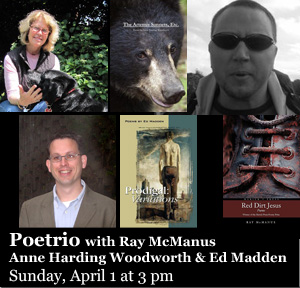
National Poetry Month begins at Malaprop’s Bookstore/Cafe with Poetrio this Sunday at 3:00 p.m. This month’s featured poets include Ed Madden, Ray McManus and Anne Harding Woodworth.

Here’s an abridged version of the poets bios from the Malaprop’s Bookstore/Café news release:

Anne Harding Woodworth is a member of the Poetry Board at the Folger Shakespeare Library in Washington, D.C.  She is a part-time resident of both Washington, D.C. and the Western North Carolina mountains. On April 1 this year, she will read from her fourth book, THE ARTEMIS SONNETS, ETC.

Ray McManus teaches creative writing, Irish literature, rhetoric, and composition at the University of South Carolina, Sumter.  We are very pleased to welcome him back with his second poetry collection, RED DIRT JESUS, for which he won the Marick Press Poetry Prize.

At the November 2009 Poetrio event here at Malaprop’s, Ed Madden read from Signals, the 2008 poetry collection for which he won the South Carolina Poetry Book Prize.  His most recent collection of poetry is PRODIGAL: VARIATIONS.

Learn more about the April 2012 Poetrio at Malaprop’s Bookstore/Cafe at their web site.

Three ways self-published authors fail

“Only idiots and the self-deluded think that being able to self-publish qualifies them to write,” concludes one person commenting on Two reasons why not to self-publish your book. It’s true. Not every self-published author writes well. For that matter, not every best-selling author writes well. I do agree in part with that comment–the logical part, not the jaded part. Like I said before, I am an advocate of self-publishing, but my views are changing.

Regarding self-publishing, I wrote a multi-part series titled The Economics of Writing. The basic premise of the series is this question: Why should a poet/writer spend his/her money on literary contests when they might self-publish his/her own work? You can read the whole series by following the links. What prompted the series was:

  1. I’ve been in publishing for a while and know how much it costs to produce and distribute print products and
  2. I read a story about a writer that spent more than $14,000 in a seven-year period on contest entry/reading fees, related postage, sample journals, literary memberships and writing conferences/workshops and won a $500 cash prize during that period.

I’ll avoid the analysis of literary contests [read about them in the second part of the series], and move to notable poets and writers who have self-published their work: Margaret Atwood, T.S. Eliot, Robert Service, Nikki Giovanni and Viggo Mortensen [read more details in the third part of the series].

When you consider the amount of time and energy–not to mention money–it takes to publish a book, self-publishing is an option to consider if you don’t want to wait for a publishing house to release your product. A poet and/or writer may spend years working with an agent to secure a book deal with a traditional publishing house. Whereas, self-publishing a book can make its way to the market in a matter of days or weeks.

Most self-published authors fail with their book releases in the following three areas:

  1. Cover design. And in general, book design. Just because you cleverly wrote your major literary work in MS Word does not mean you can print it in MS Word. Let a professional graphic designer package your literary endeavor. Further, just because you have Adobe products loaded on your fancy schmancy MAC machine, doesn’t qualify you as a designer either. Book design is not the same as designing a web site (that you really borrowed from WordPress or some other blog platform and told your client you designed their web site *sigh*). A book cover is the movie poster for the book. It must invite, entice, and coax readers to pull the book from the retail shelf (or etail shelf), read the back blurbs and first chapter, and ultimately buy the book.
  2. Editing. First draft, best draft is not the best practice in selling books. Having your ever-loving mother to review your manuscript is not that same as getting your manuscript edited. Even a good writing group is not enough–but it is a very good start. Hire a good editor to work on your literary masterpiece. A good editor will make a huge difference in the final product. So much of self-published books are deficient in quality work. There are gruesome typos, grammatical crime scenes, and abominable stylistic failures. A good editor is like a good film producer–a poet/writer may have the vision, but the editor knows best how to articulate it to readers. A good editor is one of your best friends. The last thing you want to do is release a book product that you immediately have to print a second revised edition because you used “their” instead of “there.”
  3. Production efficiency and quality. The financial bar has been lowered in matters of producing a book. Print-on-demand options are more affordable now than ever before. But more affordable doesn’t always equate to quality book product. A lot of do-it-yourselfers enjoy the look of the Etsy-ish, handcrafted book products that clutters the indie poetry and zine scene. And that’s fine. Those products are souvenir. People who purchase those items understand that they are a souvenir, book art object. But that option is more expensive than one might suspect. Consider a book’s cover price of $12 per copy for a 64-page literary chapbook. Most traditional publishers have a production markup of no less that 12 times. If, for example, the cover price is $12, than the book’s production cost–printing cost, cover art, book design, etc.–on a 1000 copies print run is $1 per copy. Most self-publishers don’t consider this fact and usually spend $6 per copy on a print run at Kinkos for a run of 100 copies. At that rate, it’s a hobby not a business.

I’ve been on both sides of the argument. I’ve self-published books that failed and succeeded. I launched two book imprints within a media organization that sold over 30,000 books in a couple of years. And here’s where I’m changing my position on self-publishing versus traditional publishing: idealism versus reality. Poet and blogger extraordinaire, Ron Silliman, offers these thoughts on idealism versus reality when he suggests that it would be ideal:

…if all bookstores carried every book of poetry that is in print… and if all poets had equal access to book publication.… But until then, it’s the real world I’m going to engage with…

So, where does that leave authors who don’t have a literary agent and don’t want to wait years and years to get their work published? Co-publishing. There are several reputable publishing houses that offer co-publishing services. A poet/writer still pays for the production of the book product, but the publishing house offers editors, publishers with decades of experience, a professional art department, a public relation staff, a warehouse facility, events coordination, distribution and other services. Consider the question that sparked the multi-part series I wrote. As a writer, would you rather spend seven years and $14,000 trying to win a literary contest and/or land a book deal? Or spend $14,000 and seven years selling your book, earning new readers and working on your upcoming books?

Book Launch for Look Up Asheville Collection II

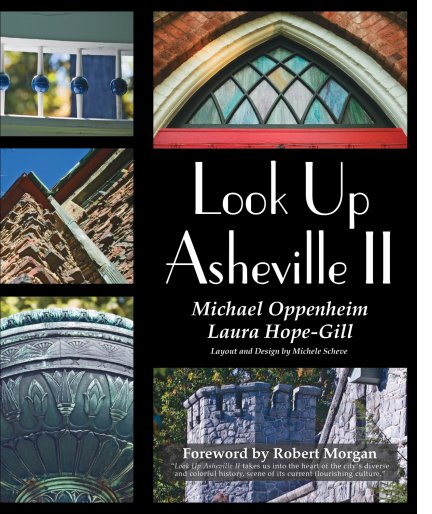
Look Up Asheville II by Michael Oppenheim and Laura Hope-Gill

Tonight at 6:30 p.m. the Look Up Asheville II book launch begins at the Battery Park Champagne Bar/Book Exchange. Join the festivities for the launch of Look Up Asheville II featuring photography by Michael Oppenheim and essays by Laura Hope-Gill. Poet Robert Morgan writes: “Look Up Asheville II takes us into the heart of the city’s diverse and colorful history, scene of its current flourishing culture.”

From the event invitation: “Look Up Asheville II features more architectural details captured by local photographer, Michael Oppenheim, accompanied by historical essays by Laura Hope-Gill, with a Foreword by premier author and poet Robert Morgan (Gap Creek, Lions of the West, Terroir). Designed by Michele Scheve, Look Up Asheville II does more than inform readers and viewers of the architectural, social and creative history of Asheville; it celebrates all these with stories and luminous images. The new book contains Asheville’s grand Bed and Breakfasts and more of the exquisitely built churches, inns, museums and downtown treasures.”

Poetry at the Altamont

Poet Laura Hope-Gill

Tonight from 7:00 p.m. until 8:30 p.m., Poetry at the Altamont continues with this month’s featured poet, Laura Hope-Gill.

It’s been awhile since I visited the The Altamont Theatre. I believe it was during last year’s Wordfest. It’s a gorgeous setting to hear poets read their work. I’m looking forward to tonight’s event.

Here’s more details about the event Poetry at the Altamont from their Facebook invite page:

Poetry at the Altamont is a reading series for poets and poetry lovers commencing on the third Monday of each month at seven o’clock in the evening at The Altamont Theatre in downtown Asheville. The event consists of a reading by the feature poet followed by an open microphone, for which readers may sign up and recite one or two short pieces. During the open portion of the event, we encourage new voices and accomplished poets alike to share what they have been working on, a space where writers have the opportunity to try out new works in front of an audience on a regular basis. Please join us for consistent, fine poetry in a setting that is equally fine.

Hosted by Jeff Davis and Laura Hope-Gill
Produced by Caleb Beissert and Aaron Price

$5 at door
Beer and wine served

(link)

retro-dolls:

This looks perfect

Quote

Poetry at its best is the language your soul would speak if you could teach your soul to speak.

—Jim Harrison, from his essay “Poetry as Survival” in Just Before Dark: Collected Nonfiction (Clark City Press, 1991)

(via apoetreflects)

Two reasons why not to self-publish your book

Confession: I am an advocate of self-publishing. I have been for years. But my views are changing on the matter due to the glut of poorly written self-published books being released each year.  Serendipitously, I found this article in the London Evening Standard that offers two reasons why not to self-publish: 1) publishers and 2) editors.

Authors need publishers more than ever when there are so many voices out there competing for our attention. As Horowitz rightly says, the main raison d’être of a publisher is to provide the author with a skilful editor who can turn a sow’s ear into a silk purse.

Editors are the midwives of great literature. T S Eliot’s The Wasteland wouldn’t have been the masterpiece it is if it hadn’t been edited by Ezra Pound and his wife, Vivien.

The death of publishing is greatly exaggerated. We will still need publishers as long as we read books, just as we still need critics to review those books. It is part of the great filtering process of literature and culture. (link: Self-publishing makes us think we can write)

Any questions?

Quote

My exasperation about the cowardly evasiveness of our mainstream press drives me to think that if people in general knew more about history they’d be more likely to demand more honorable governments.

—Robert Wyatt, BOMB 115, 2011

Judging a book by its cover

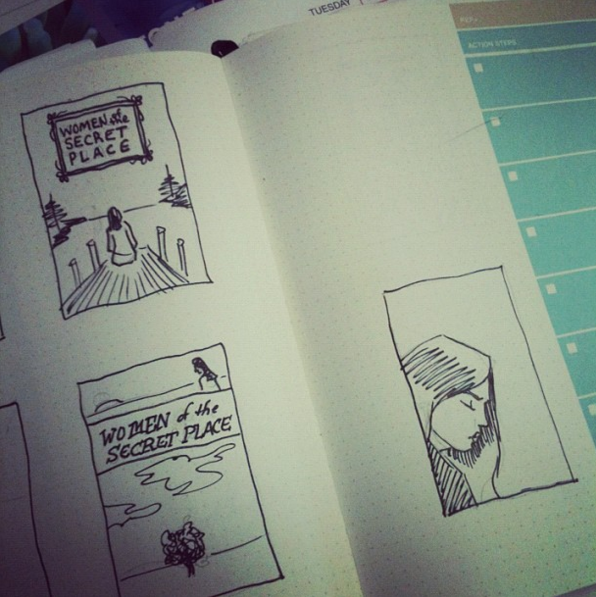
For me, every book cover I design begins with pencil sketches that eventually lead to ink drawings. Actually, I suppose it begins prior to that. The author receives a pre-publication questionnaire from me prior to the design process. The questionnaire asks the author what is his/her elevator pitch, what are the pillars of the book (i.e. what are three main concepts/ideas in the book?), and what is the book’s key audience? There are more questions that help me prepare for the design process, but reading through that document helps me form an idea of who the author is, what the book is about and how best to represent the book’s content with an attractive cover.
Then I receive the manuscript a few weeks later and begin reading the author’s work. This helps try to envision in my mind an iconic poster image. For me, a book cover is the equivalence of a film poster. At this stage, I produce some concept drawings (like the one’s pictured) and research color schemes and subject themes that I plan to use in the cover design. After a couple rounds of emails with the author, I proceed to the full-color design phase.

The full-color design is often photographic, as in the case of this sample, but can also feature illustrated work or typographic designs. An illustrated cover is sent to a freelance artist who spends a week or so producing the cover art. The final cover design pulls together all the elements (art, photo, type and copy) to present a cover that, in theory, sells a 1000 to 3000 copies on face value. I know what you’re thinking, but books really are judged by their covers. Just watch people at a bookstore. They’re scanning covers before they even pick up a book to read the back copy blurb or open a book to read the first few chapters. If a book has amateurish art or less than professional photography, the audience will move to the next book cover that has great photography or stunning artwork. Further, if a book has poor quality cover art, it will be represented in poor book sales. Let me say it again: if a book has crappy cover art, the book will have crappy sales. No reader wants a crappy book on their bookshelf or e-reader. Half the battle for a reader’s attention is getting him/her to pick the book from the shelf. The same applies to e-book stores. Readers are scanning covers from the Kindle or Nook e-stores and deciding, based on cover design and book blurb, what title to purchase.

From the time the final cover is approved until the product arrives is six to eight weeks depending on circumstances. That’s when the real test of a book’s cover design and interior content begin. And that’s about the time I begin the next round of cover designs.

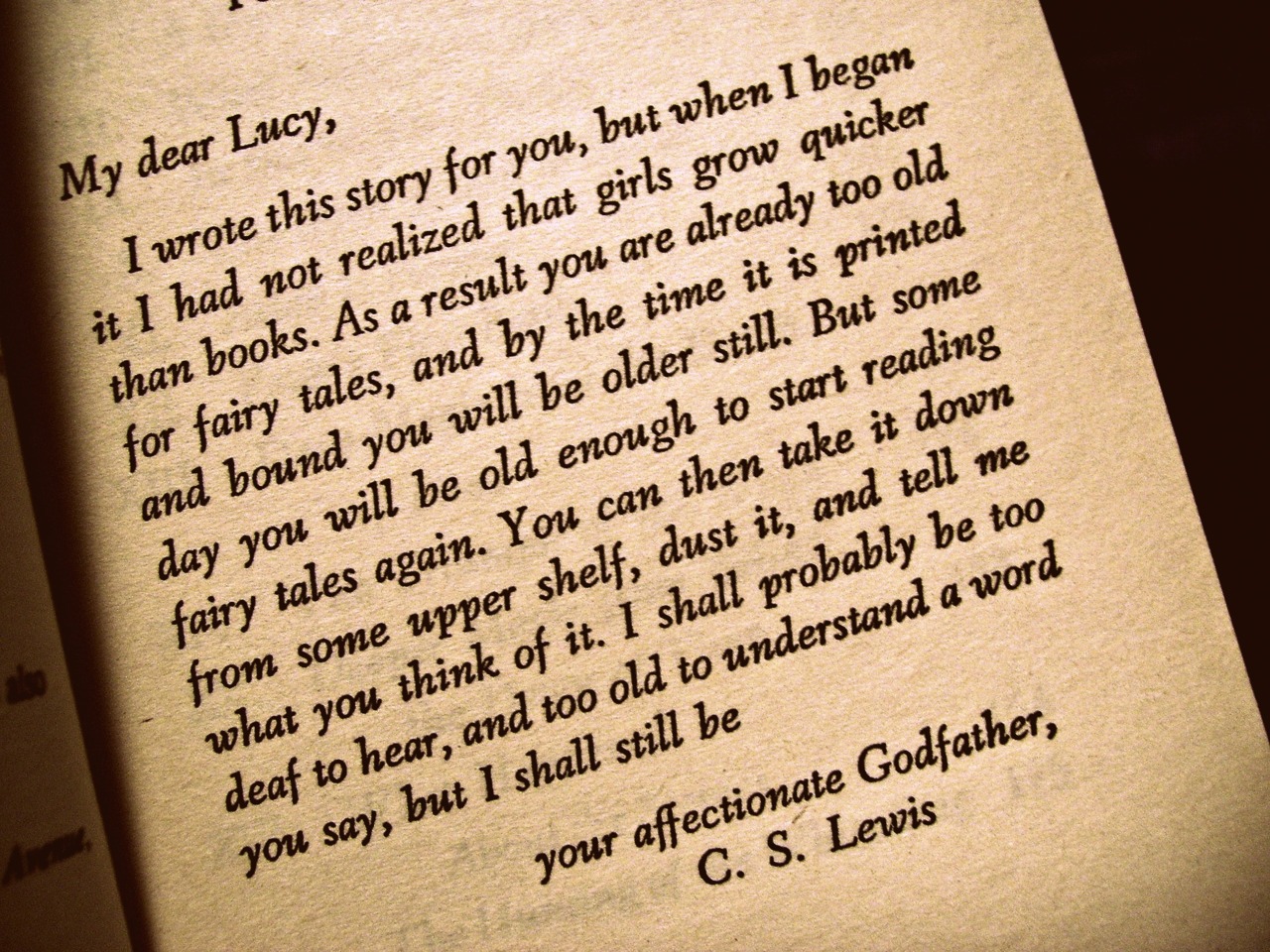
“I wrote this story for you…”

via myheadandmyhearttoday

Literary reading series continues at Posana Cafe this weekend

Saturday night, March 17,  6:00 p.m. at Posana Cafe in downtown Asheville, NC. The literary reading features writer Elizabeth Lutyens and poet Tina Barr.

From a press release:

Elizabeth Lutyens teaches the Prose Master Class in the Great Smokies Writing Program of UNC Asheville and is Editor of The Great Smokies Review, its online literary journal. A former journalist, she got her MFA in Creative Writing from Warren Wilson College, and since has been at work on a novel set in the mid-19th century in Boston and the Port Royal Islands of South Carolina.

Tina Barr has received Fellowships from the National Endowment for the Arts, the Tennessee Arts Commission and the Pennsylvania Council on the Arts. Her awards include the Editor’s Prize for book publication from Tupelo Press. Her poems are published in anthologies and journals like The Harvard Review, The Southern Review and The Paris Review.

Gen-Yers changing the workplace

Gen-Yers are using their personal networks and profiles as an extension of their professional personality. Even though they are using Facebook to mostly socialize with family and friends, they are inadvertently blending the two. Sixty-four percent of Gen-Y fails to list their employer on their profiles, yet they add an average of 16 co-workers each to their “friend” group.

Generation Y: The New Kind of Workforce (via thenextweb)

Quote

As the trend frenzy deepens, we can see that fashion is no longer about style and self-expression: it is primarily about judgement – self-judgement and judgement of others.

~The Tyranny of Trends1

(via somethingchanged)2

NOTES:
1) “The Tyranny of Trends,” Etsy, 2011, accessed March 9, 2012, https://www.etsy.com/blog/2011/the-tyranny-of-trends (page no longer available)
2) Something Changed, accessed March 9, 2012, https://www.somethingchanged.com.au/post/8515000829 (page no longer available)

How These Magazines Increased Circulation While the Industry Declined

True Blue quotes artist Vadim Bora.

Print Design Garners 93% of All Media Created

(via Full Circle – Paper + Print + Design)