Graphic designers solve problems. They educate clients as much as they create products for clients.
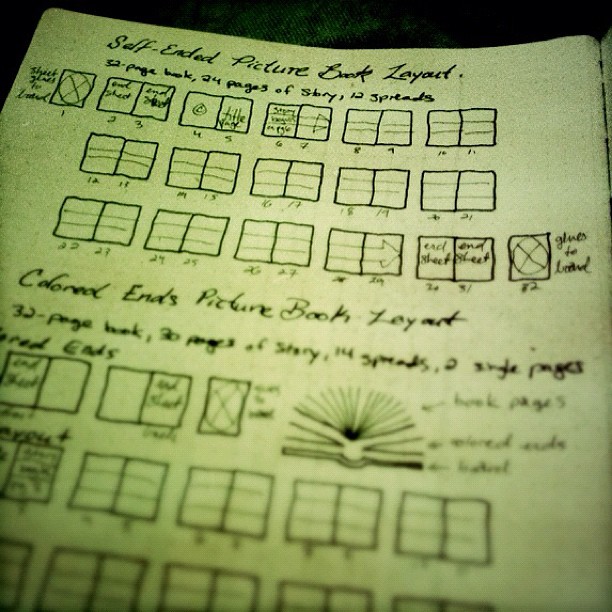
In an old Action Book journal, I sketched the details and differences between two options for a picture book. Most people see picture books all the time, but may not be aware of how they are put together. This sketch helped illustrate for the client and author how best to plan for their project.
That client meeting was years and years ago. Now I have stacks and boxes of these design journals. From time to time, I open these journals to reference an idea or sketch. But maybe it is time to start recycling them.
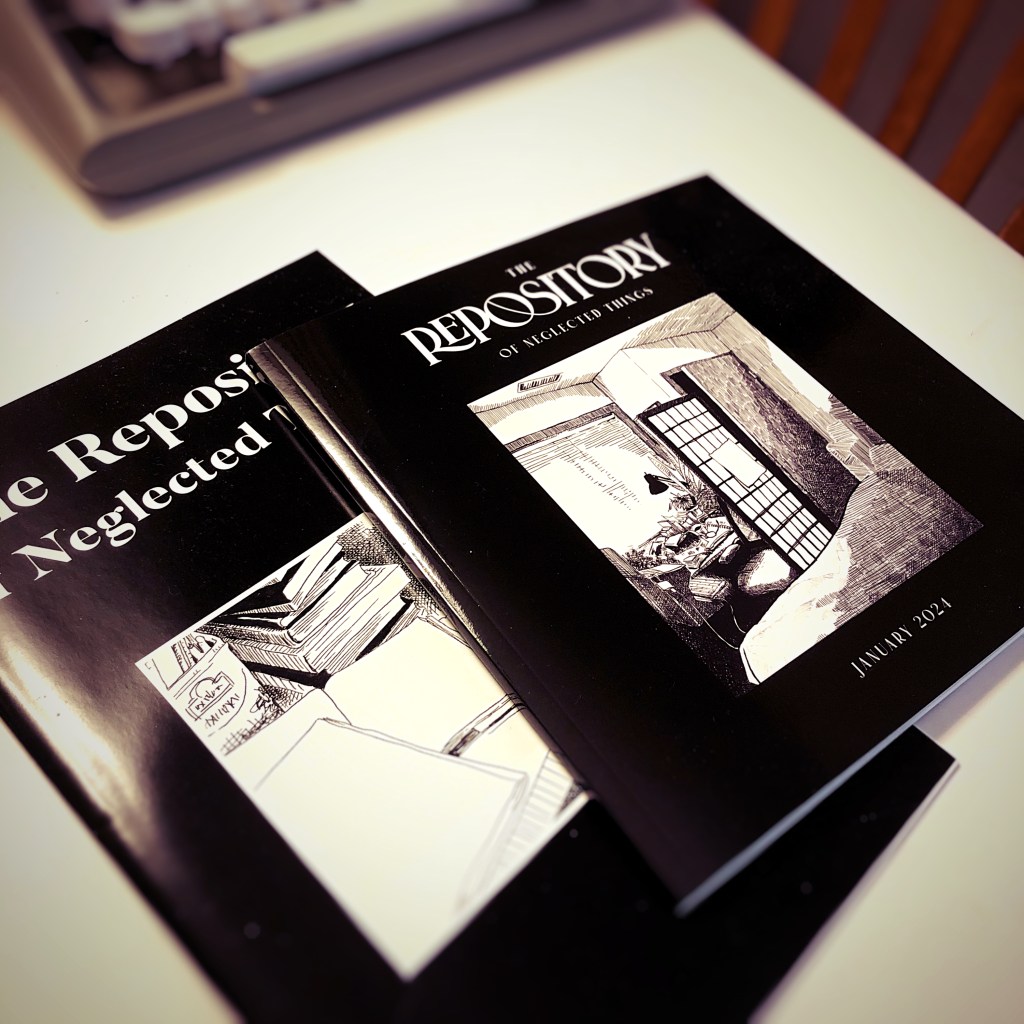
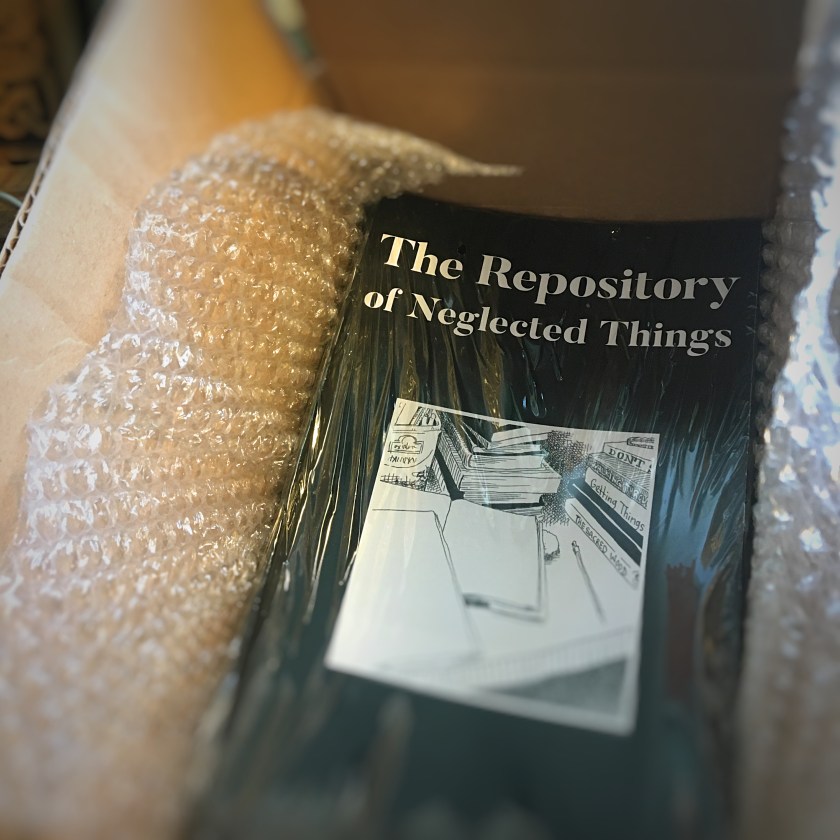
A couple of the drawings and illustrations featured on this web site during the last month or two appear in The Repository of Neglected Things. This private project originally started as way to collect unpublished drawings, illustrations, and stories into a physical package for friends and family. An anthology, if you will. Or maybe a portfolio. Plans are in process for a third and fourth volume. It has a limited print run. And distributed privately by invitation only.
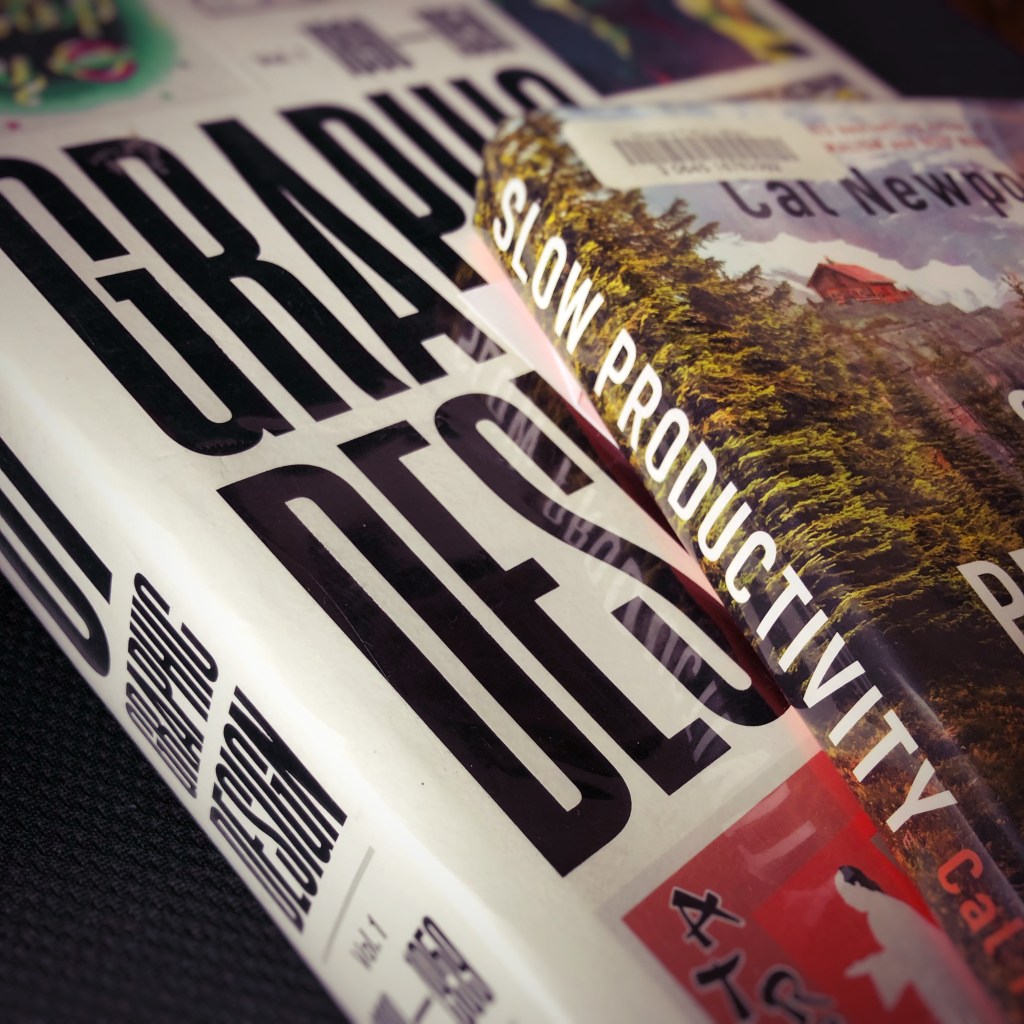
The interlibrary loan system provides access to books. Books that are not available at the local rural public library. Books requested using the library system’s web site arrive as they are available. Sometimes the combinations of titles display a curious serendipity. Slow Productivity. And History of Graphic Design Volume 1 1890 – 1959.
The principles featured in Slow Productivity appear to contrast with the other book. At least at first glance.
Graphic design projects and tasks were once defined by art and drafting skills. Tactile skills of cutting an oval with an X-Acto knife for a Rubylith overlay sheet. Or drafting skills of using a T-square ruler and triangle to layout the ad copy for an advertisement. Or the skill of painting a headline with gouache paints or pigment inks. Or the photographic skills of loading, shooting, processing, and printing 35mm film. Graphic design work prior to the 1990s required more physical activity. Often, a design shop featured multiple creative talents. A photographer. An illustrator. A copywriter. A director and assistant. A typographer and designer. A videographer and film and audio editors. That is a team of ten creatives. Now graphic design projects and tasks encompass project management and problem solving. And a single designer needs to do the work of ten creatives.
Can graphic designers do their projects and tasks without burnout? That is the question. And, maybe, that is where the interlibrary loan library books compliment each other. Can the past inform the present? And future? And, more uregently, can I read these books before they are due back to the library?
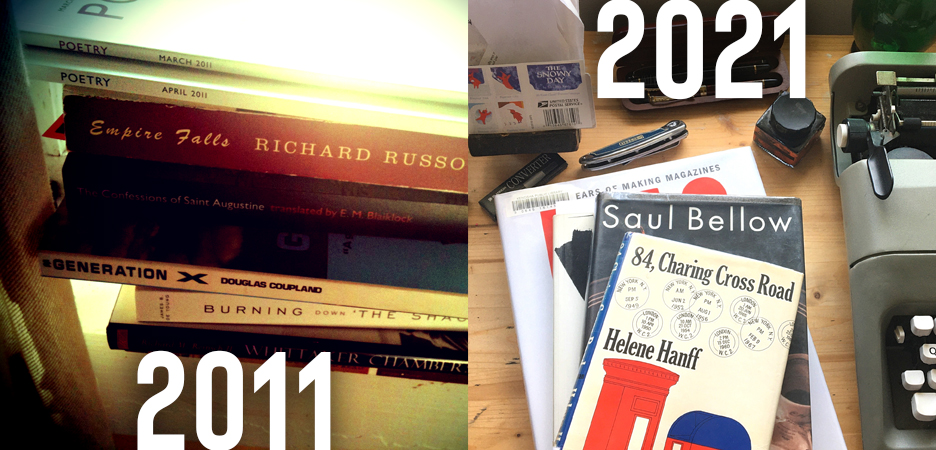
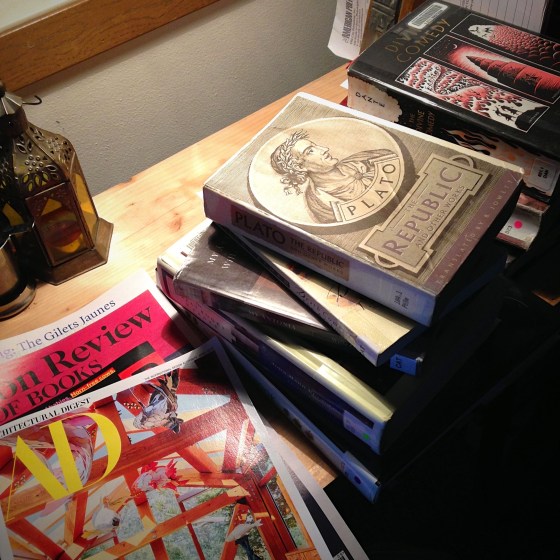
Ten years ago I published this photo of a nightstand stack of books. I looked at the photo and wondered what changes occurred in my reading habits or tastes during the last ten years. Then I asked, what is on my desk today? After some thought, I wrote a blog post. Or rather an essay regarding my observation. But it was long.
I did not publish the post. Instead, I merged the photos together for comparison. Pictures are worth a thousand words. In this case, two thousand words. And this post will only take a minute to read, rather than 15 to 20 minutes.
A drawing of my desk with books read, unread, or partially read.
It is a challenge for me. When I am introduced as an artist and/or poet. Still not comfortable with either of those nouns. The next question is inevitable. It usually goes something like this:
My wife turns and introduces me to her friend and adds, “He’s also an artist and poet, too.”
“Wow, can I see your art work on Facebook?”
“No. I am not on Facebook.”
“Oh. Instagram?”
“No. Not on Instagram, either.”
“Well. Um. What do you do? Oil paintings? Do you have a gallery somewhere?”
“He posts some of his work on his blog,” my wife offers.
About that time the bread crumb trail ends and the conversation shifts to something else.
The trouble is that some of the work I create I cannot contractually share. Technically, I do not own the copyrights to the final art. And so, I cannot distribute or display it on this or other online platforms. Frustrating. Yes. Bad. No. It is the cost of commercial arts.
For example, a couple weeks ago I drew a portrait. A line art drawing. The portrait will be featured as an etching in either crystal or acrylic as part of a lifetime award. Sometime in March. You may have seen such awards in business offices. A crystal award on black base sitting on someone’s desk or shelf or trophy case.
I am reminded of one of Milton Glaser’s mottos: “Art is work.”
Milton Glaser, celebrated graphic designer, may not be a household name. Not even in my home. But most Americans will recognize the I [heart] NY logo. It is highly unlikely that school children will study designers as part of their art curriculum. (My children are presently studying the American painter Andrew Wyeth.)
Too often I lament, or rather, complain that I spend too much time creating work in front of a screen. It was so nice to ditch the screen and work in ink on vellum and illustration paper. Took nearly four hours to draw the portrait. And that is with the interruptions of replying to emails and designing elements for a multi-page editorial piece. It would take four weeks if I tried to craft the portrait as an oil painting.
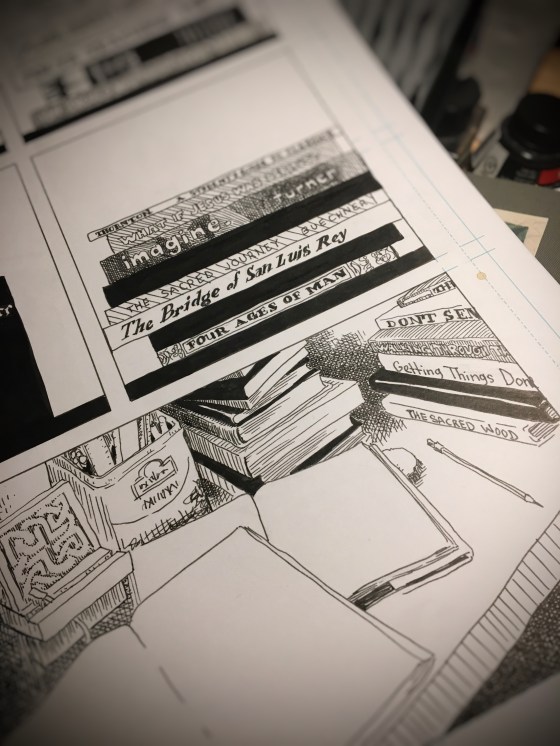
In order to answer a request (Where may I find your art work?), I drew the above page last weekend. Inspired by Jane Mount’s Ideal Bookshelf, I managed to draw the stacks of books on my desk by the bedroom window. At least fifty books. So many books. So little time. I enjoyed the exercise. It felt good to pencil a sketch, flesh out the details, and ink the page.
“Wait. You write poetry, too?”
“Um…” I start.
“Have you been published?”
“Yes,” I say.
And this time the bread crumb trail ends quickly. Because most people do not know where to begin to look for published poetry.
“He posts some of his published poems on his blog,” my wife adds.
Saturday mornings. The work week is done. Sunrise is an hour or more away. The windows open. And have been all week. Unusual for this time of year and this part of the country. Birds create a pre-dawn cacophony in the evergreens outside the windows to the east.
The oldest kidlinger is up early doing laundry. Needs clean clothes for work later today. We move about the apartment quietly.
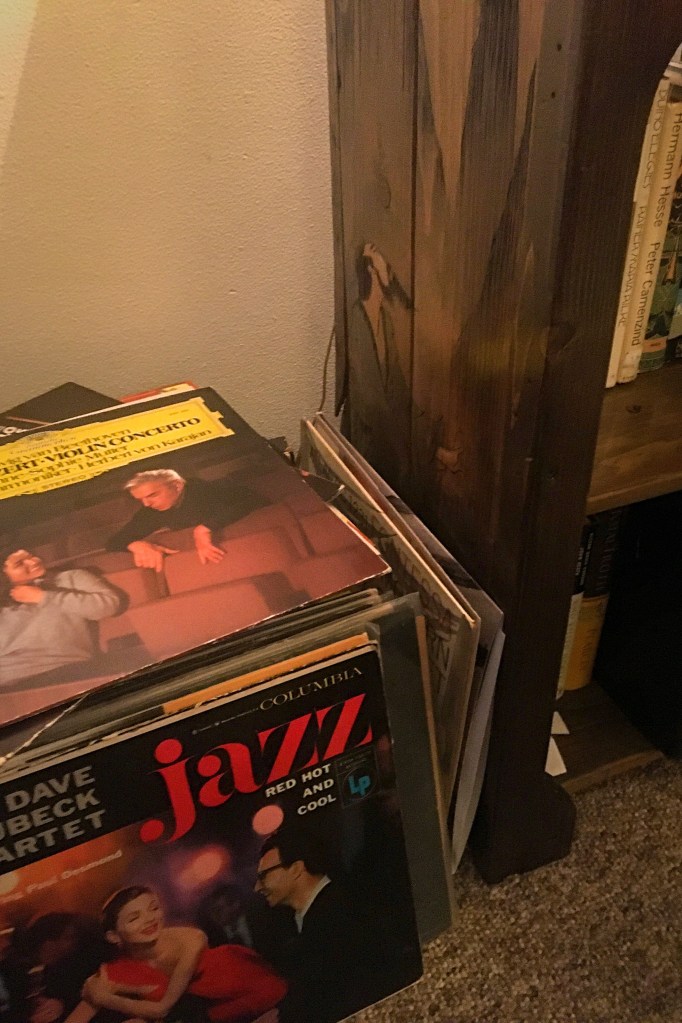
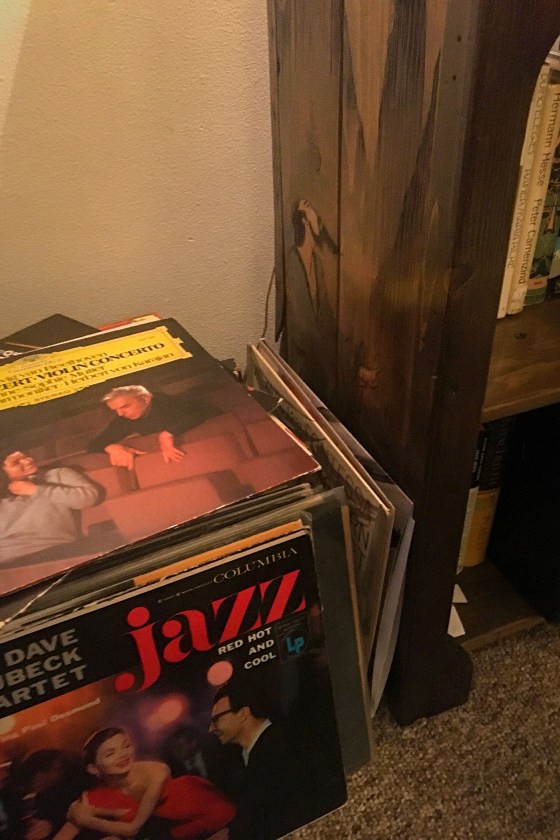
Saturday mornings are time for jazz. Brubeck. Coltrane. Evans. Tatum. But it is too early for Saturday morning jazz. It is time for stillness. A time to plan, think, and meditate.
* * *
Conversations from the week come to mind. What makes a good book?
There are good books. Or at least, interesting books. There are poorly written books. And bad books. Meaning stylistically bad (as in the content is unsuccessfully researched, appallingly argued, or intentionally misleading). There are well-written books with poorly argued thesis statements. There are dull books with good data. And there is a bookshelf that holds them together.
The no-plan, salvaged-wood bookshelf collects a portion of my library. The space between the work-from-home station and the vintage stereo is the new home of the bookshelf. The summer therapy project was completed so late that the intended use for the bookshelf for school materials was no longer relevant.
The relevance is now my education. My continuing education in art, science and religion. Essentially, philosophy. What is truth? And, how do I know it? Variations on a theme. A book about technology. Another about project and time management. The top shelf nearly all books of poetry and essays. Some memoirs and novels. Several books on theology and spirituality. Books by American writers. British writers. And German writers.
The second shelf. A mix of poetry, fiction, essays, art and design. The third shelf. Memoirs, classical education, technology, theology, and philosophy.
Reading an abundance of books does not make an individual well-read. Reading great books does not make one well-read. Understanding the great conversation makes a reader well-read.
* * *
“I don’t read books,” he said. I did not know what to say. “I read the newspaper. Mainly the sports page. But that’s it.”
I recalled the conversation from a few years ago. At lunch. On the patio of the Knickerbocker Hotel. The thought appalled me. Not the person. He’s a good guy. But no book reading? How is that possible?
And I know how this happens. Happened. Long days of work. Long commute. Family responsibilities. Community engagement. And other demands. Priorities need to be made in order to set and accomplish goals.
* * *
Found myself in the recliner. Everyone asleep. It was late. The lamp near the recliner was on. All other lights were off. The apartment was dark. A copy of the New Yorker on my chest. The record player was on. Three records on the platter. Waiting to be reloaded on the center spindle.
I had fallen asleep. Midway through the tables for two section of the magazine. Could not even keep my eyes open. Did I eat supper? Or dream of eating it? Or dream of reading that I ate it?
Who has time to read legacy publications? Will try again on the weekend.
I folded the magazine cover to the back so that the page I had read was open. And placed it on the top of the bookshelf to read later. Then turned off the lamp.
* * *
How did it get to be noon? How did it get to be Saturday?
The sun is bright. Warm November breeze rattles the remaining brown leaves on the tree outside. Art Tatum plays from the record player.
I return a small book to the bookshelf. I place it open on the top shelf of the no-plan, salvaged-wood bookshelf I built this summer. The shelves are deep. At least a foot deep. Could hold two rows of standard-sized paperback books.
I place the book open on the top shelf. A reminder for me to return to the passage that captured my attention. Imagination. A bread crumb trail back to an idea.
The next vinyl record drops down the spindle. Bill Evens. Peace Piece. It is Saturday morning jazz slouching toward afternoon.
The book reading routine I was accustomed to six years ago is nearly unobtainable at this present time. However, I did manage to read quite a few thick books both in content and page count. Here is a short list of 12 books read in 2019:
Amusing Ourselves to Death, Neil Postman
Bright Moon, White Clouds: Selected Poems of Li Po
The Cellist of Sarajevo, Steven Galloway
Facing the Moon, Li Bai and Du Fu
Hamlet, William Shakespeare
Julius Caesar, William Shakespeare
Lament for a Son, Nicholas Wolterstorff
Macbeth, William Shakespeare
My Antonia, Willa Cather
The Poems of T. S. Eliot
The Republic, Plato
Total Truth, Nancy Pearcey
This is not a complete list. And a few of the books were a second reading. It is safe to say, there is not a single book on my reading list that appears in the best books of 2019 lists of Chicago Review of Books, the Guardian, Washington Post, or the New Yorker.
Whether poetry or play, novel or nonfiction, these 12 books are recommended. Which of these books is my favorite? Some of these books challenged ideas, disturbed my understanding of the cosmos, and lead to changes in my life. But which is my favorite?
How many books did you read last year? According to some reports, one in four Americans did not read a single book in the last twelve months. Three out of the four who did read in the last year read only one book. But the reports are even more dismal when a distinction is made between any books and books of literature. For example, books on business, cooking, gardening or self-help are in a different category from books of literature. Further, books on business and marketing by Tim Ferriss, Seth Godin or Simon Sinek are not considered literary works. Books by Dante, Plato and Shakespeare are works of high literature. Books of literature by American authors include Flannery O’Connor, Robert Frost and Thornton Wilder.
My own reading pattern shadows the national trend. This discourages me. Years ago I read more than 50 books a year. In addition to that, I used to read several literary journals, magazines and newspapers on the bus ride to the office each day. It was a delicious and robust period of time. But life interrupted this reading regimen. A dream job, mega commute, cross-country move, career change, new job at a legacy media organization, and more commuting disrupted my reading habits.
It is a struggle for me to completely read one single book from cover to cover. The desk in front of the window holds eight books. I may have to return all these to the public library partially read. Or renew them. The library must be weary of me renewing a copy of a theological book. I must have renewed it several times over the last few months. One report I read stated the reason people do not read books is due to their busy work/life balance.
Great disruption.
The interruption to the reading habit is due in part to the daily commute. 90 minutes a day spent traveling from home to work. Public transit would be nice. However, no public transit system services the rural communities surrounded by cultivated fields and farmland. Travel accounts for more than 15 days of my time each year. And then there are the long hours of production work. The job is mentally demanding. My fatigued mind only desires to turn on the record player and go to sleep when I return home.
Solution.
Most Americans spend more than two hours each day on Facebook, Instagram, LinkedIn and Twitter. That equals more than 40 days a year. From an economic stand point that seems like a lot of wasted productivity. What that means in practical terms is that my social media feeds are on life support. I do not spend time on Facebook or Twitter at all. LinkedIn occasionally. And I deleted my Instagram account. Eliminating social media activity allowed me to reclaim some of the time lost to commuting and work.
Great books.
A second action put into practice during the last few years included reading great books of literature. Mostly. Plato’s The Republic, Beowulf, Sir Gawain and the Green Knight, The Autobiography of Benjamin Franklin, Booker T. Washington’s Up from Slavery, The Autobiographies of Frederick Douglas, Tolstoy’s Anna Karenina are some of the books read during the last year and a half. The classical education curriculum of my children helped me form a list of great books to read. I added a few books to the list to include Asian and Near Eastern studies. I explored Basho’s The Narrow Road, an anthology of Rumi, Hafix and Lalla, and Ryokan’s Sky Above, Great Wind. Most recently I attempted to read and compare three different translations of Dante’s Divine Comedy. An ambitious task that I failed. Ended up focusing on selected cantos for comparison before the books were shuffled back to the public library.
The virtue of reading.
Why is reading books, especially, great books, important? The virtue of being well-read is the goal. Do not leave it up to the academics and professionals to read great books. C. S. Lewis wrote that “the simplest student will be able to understand, if not all, yet a very great deal of what Plato said; but hardly anyone can understand some modern books on Platonism.” He continued by encouraging readers to acquire firsthand knowledge of the source material rather than to rely on secondhand commentary. Being a well-read individual has the potential to foster a civilized society. But you must be vigilant, designate time, pick up a book and read it cover to cover.
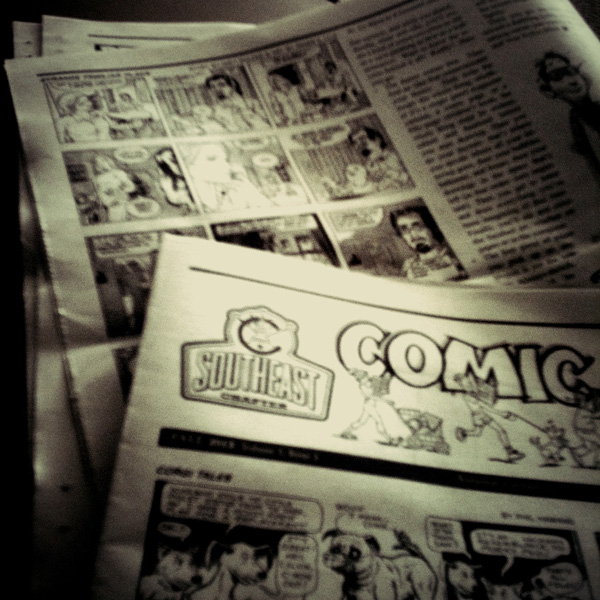
After nearly a six-year hiatus, I was excited to see a project that began with notes and sketches transform into a published comic strip. Even if it was a one-off. Even if I had to hand the responsibility of drawing each panel to someone else. It was done.
I had imagined that the creative non-fiction comic story I crafted would earn some interest. Maybe it would open a few doors to an audience. And allow me to write and illustrate. Even earn some money. Maybe I would quit my day job and provide for my household by doing something I loved. Telling stories. And drawing pictures.
That was five years ago.
A few weeks ago I found a box in the garage. It had several copies of a publication that printed my comic strip. I glanced over the pages and then placed them back into the box. I also found several books. Opened one book I remembered enjoying.
“What’s that?” asked one of the children.
“It’s a collection of comic strips.”
“Oh.”
I pulled a copy from the box and gave it to the child.
“There’s a story in there I wrote.” I said. “See if you can find it.”
The child took the copy of Comic Stroll and headed off to the couch in the living room.
I flipped through the pages of the book I had found. Read a few highlights.
Yeah, I resemble that, I thought to myself after reading a few lines at the end of the book. The author referenced a friend of his who gave up an art gig for a corporate job in order to provide for his family.
Yeah. I know what that is like.
How many comic pages might I have written and illustrated if I had. . . Well, what-ifs and might-have-beens are dangerous paths to pursue. What you did, great or small, is what matters.
Watching my progeny spend an afternoon reading comic strips I had a hand in creating was a pleasure.
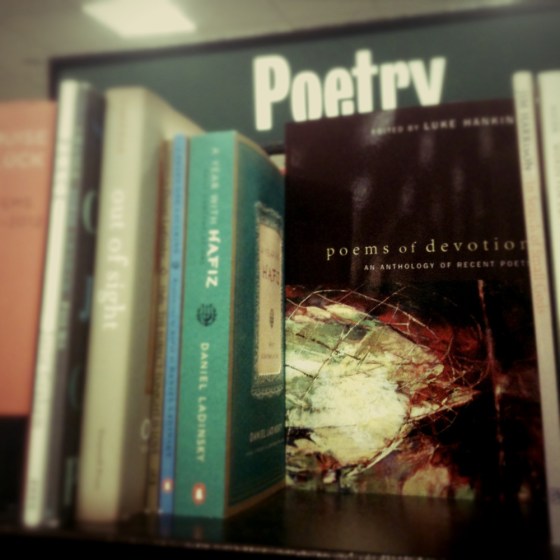
The best way to share poetry with people — who do not know that they may like poetry — is to start by reading the works of living poets. That is the basic idea of my poetry reading list for National Poetry Month.
Most books lists of are just lists. Promotional bullet points. Usually there is an image of the book or photo of the poet, a brief description or summary, sometimes even a list of credentials and awards, and a hyperlink to the poetic work or an online retail store. That is an approach I will try to avoid.
I read recently that the ancient Greeks and Romans enjoyed literature in a very different way than our modern culture — where we silently read books. The ancient poets read and/or recited their work out loud to a public audience.
So, my poetry reading list for National Poetry Month is designed to encourage you to seek out the influence of living poets — where they live and and where they read.[1]
The best way to share poetry with people — who do not know that they may like poetry — is to start by reading the works of living poets. That is the basic idea of my poetry reading list for National Poetry Month.
Most books lists of are just lists. Promotional bullet points. Usually there is an image of the book or photo of the poet, a brief description or summary, sometimes even a list of credentials and awards, and a hyperlink to the poetic work or an online retail store. That is an approach I will try to avoid.
I read recently that the ancient Greeks and Romans enjoyed literature in a very different way than our modern culture — where we silently read books. The ancient poets read and/or recited their work out loud to a public audience.
So, my poetry reading list for National Poetry Month is designed to encourage you to seek out the influence of living poets — where they live and and where they read.
Heather captured some great photos from the 2015 poetry marathon. Those photos are lost somewhere on Facebook. It was the first time I read at Woodland Pattern. And the first time I read along side the best poets in Racine. It was a magical night.
The Annual Poetry Marathon & Benefit at Woodland Pattern, Milwaukee, begins at 10:00AM. $10 donation taken at the door. I will be reading between 4-5PM. I would love to see you there and say “hi” and “thank you.”
Sponsor me by donating $5 or whatever using Woodland Pattern’s PayPal donation button (click here). Any amount helps. Make sure you enter “Matt Mulder” in the space provided for “Reader’s Name.” And thank you for your support!
This question seems so simple. But, what is money? How is happiness defined? Does the question imply that money means an individual is rich? Is being rich and being wealthy the same? Or different?
My reading list, as of recent, includes a book on business management, two history books and a book researching the characteristics of the wealthiest Americans. Also, included are several books of poetry by Berryman, Bly and Carruth as well as a novel by A. S. Byatt.
Almost every one of those books mentioned either directly or indirectly touches on the subject of money and happiness.
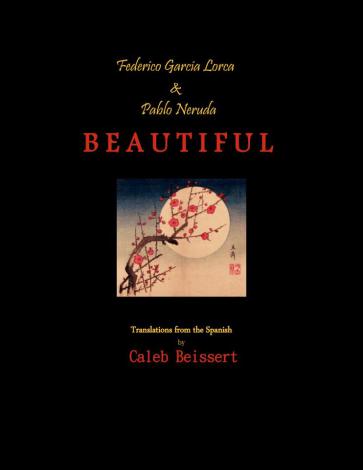
Caleb Beissert is a poet, translator and musician. His published work appears in International Poetry Review, Tar River Poetry, Asheville Poetry Review and Beatitude: Golden Anniversary, 1959-2009.
This week, Poetry at the Altamont celebrates the release of Caleb Beissert’s first book, Beautiful, a selection of poems by Pablo Neruda and Federico García Lorca translated into English. During the last few weeks, Beautiful was well received by enthusiastic audiences at Montford Books & More and Malaprop’s Books & Cafe and is a Small Press Distribution best-seller.
The Altamont theater doors open at 7:00 P.M. for Poetry at the Altamont. Admission is $5 at the door. Beer and wine sold at the bar and lounge will remain open for drinks after the reading. Event link.
UPDATE: Caleb Beissert is the featured guest of the Coffee with the Poet Series, Thursday, February 21st at 10:30 a.m. at City Lights Bookstore. Event…
Since the publisher posted the following on Facebook last night, I guess it is alright to unveil a new book I designed:
Jordan Rice’s debut poetry collection, CONSTELLARIUM, a finalist for the 2015 Orison Poetry Prize, is now available for pre-order at a discounted price! Order now and be among the first to receive the book when it’s released in April.
“Constellarium is a bold announcement of a new poetic voice to be reckoned with. These poems make us stare down shame and celebrate transition, celebrate the body inside. Jordan Rice does not flinch from what society would have us try to look away from, instead she carefully constructs a book in which we are forced to reckon, layer by layer, with her being. Let us be thankful that such a voice exists, that it is brilliant and shattering, and here to take us all on her journey.” –Fatimah Asghar
The process of cover design is exciting. Especially when the title of the project is constellarium.
There are so many stories behind the cover design that would be fun to share. Like, for example, how the kidlingers enjoyed the image of cetus — how cetus does not look like any image of a whale they have ever seen in a picture book. And how the eldest kidlinger is writing a report about rhinos.
And how a species of rhino has been reported extinct. And we wonder if these old drawings are accurate. And that maybe the cetus represented in the book cover art is correct. But maybe that species of ceti (is that the correct nominative plural of cetus, Latin students?) is now extinct.
Maybe these behind-the-scenes stories are more interesting to me than you.
See if you can find cetus in the cover art by pre-ordering Jordan Rice’s Constellarium!
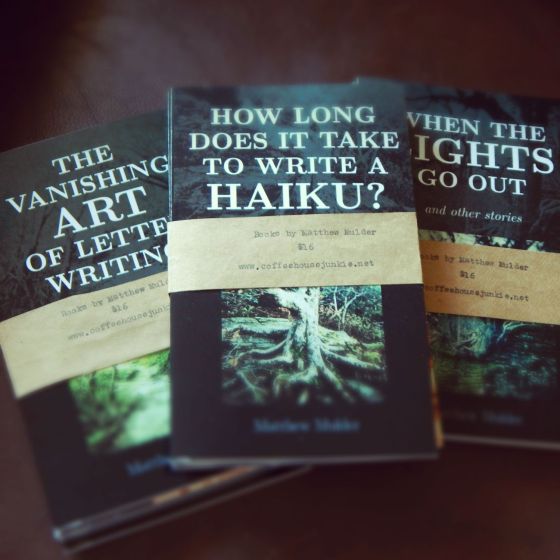
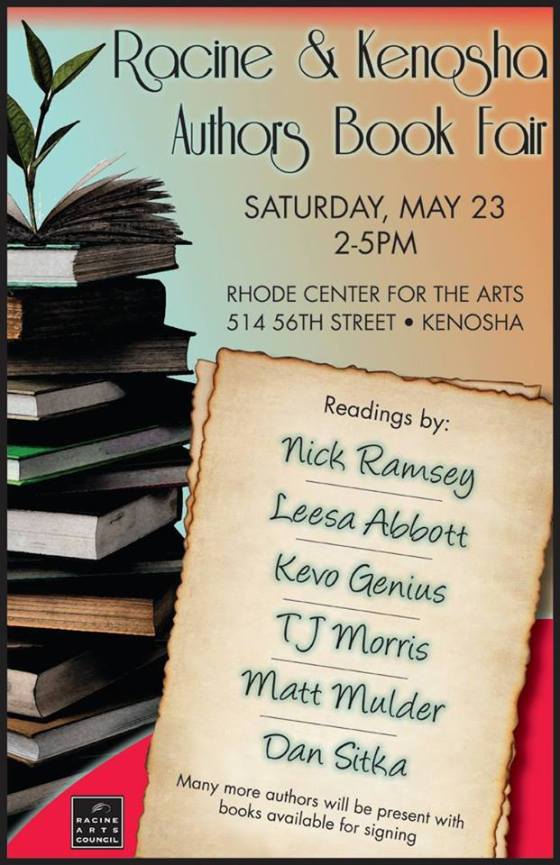
Who doesn’t like a deal? This weekend only at the Racine & Kenosha Authors Book Fair (Saturday, May 23, 2015, 2-5 p.m., Rhode Center for The Arts), you can purchase copies of my books for special book fair price: four books for $16. Limited quantities are available. So come early. See you there.
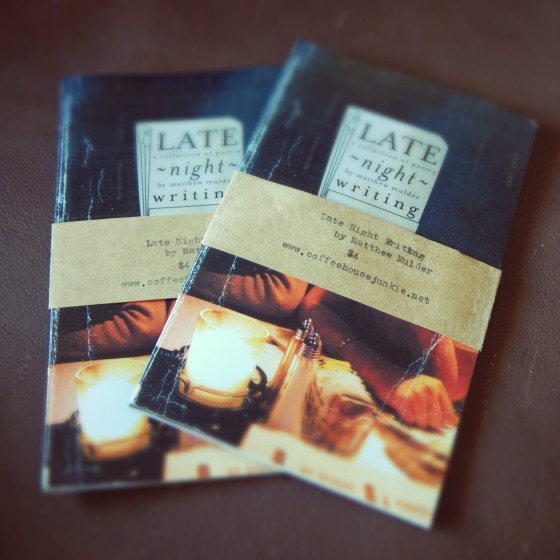
Late Night Writing is now in its third printing and the new edition features a foreword by the poet Pasckie Pascua. Copies of Late Night Writing will be available the Racine & Kenosha Authors Book Fair is this weekend, Saturday, May 23, 2015 at Rhode Center for The Arts. A special book fair price makes it very affordable to purchase and I will personally sign your copy (and if you ask nicely, I may even add a quick drawing/sketch).
With that in mind, the Racine & Kenosha Authors Book Fair is next weekend, Saturday, May 23, 2015 at Rhode Center for The Arts (514 56th St, Kenosha, WI 53140). The book fair begins at 2 p.m. and concludes at 5 p.m. So you have plenty of time to do your morning errands or yard work, join me and fellow authors and then spend the rest of the day enjoying Kenosha’s lovely lakefront area with an armful of books by local authors.
Copies of my books will be available for sale (and I will personally sign your copies) and I am scheduled to read at the event. Look forward to meeting you at the Racine & Kenosha Authors Book Fair nest weekend!


 Coffeehouse Junkie